Acronis uncovered PATCHCORD, a stealthy backdoor targeting Afghan telecom and South Asian infrastructure via fake VPN tools and Google Sheets C2.
Researchers at Acronis just documented an espionage operation that reads like it was built by someone with genuinely good taste in disguises. Their Threat Research Unit report tracks a previously undocumented backdoor called PATCHCORD, hitting Afghan telecom providers and South Asian critical infrastructure through fake VPN installers and management tools branded to look exactly like the real thing.
“Acronis Threat Research Unit (TRU) has identified an ongoing campaign delivering a previously undocumented custom backdoor against Afghan telecom providers and South Asian critical infrastructure organizations. The backdoor, tracked as PATCHCORD, is a compiled C/C++ implant delivered through sector-specific lures, including fake VPN installers impersonating Afghan Telecom (AFTEL) and telecom management tools.” reads the Acronis’s report. “Infrastructure pivoting uncovered SHEETCORD, a Go-based implant that builds on PATCHCORD’s capabilities while abusing Google Sheets for C2 communication. The malware was actively distributed through a domain impersonating India’s National Informatics Centre (NIC).”
The delivery method leans hard into specificity. One installer impersonated Afghan Telecom down to matching the company name, product fields, and even the URL of the real support portal customers actually use, the kind of detail that only comes from someone who studied the target closely rather than mass-producing generic lures. Click through it, and a 64-bit Windows implant quietly installs itself while a real browser session opens normally in the background, so nothing looks wrong to the person who just got infected.
PATCHCORD’s persistence trick is worth pausing on because it’s genuinely sneaky. Instead of the usual registry-only approach, it hijacks the actual shortcut files for Edge, Chrome, and Firefox, backing up the originals and rewriting them to launch the malware first, silently starting the real browser afterward so the shortcut still works exactly as expected.
“PATCHCORD establishes persistence by hijacking browser shortcuts. Before modifying shortcuts, the implant checks whether it is running with elevated privileges and then attempts to hijack shortcuts for Microsoft Edge, Google Chrome and Mozilla Firefox.Browser identifier and executable-name mapping.” continues the report.
“The implant searches for shortcuts associated with Microsoft Edge, Google Chrome and Mozilla Firefox before attempting to hijack them.”
Every time someone clicks their browser icon, the malware runs invisibly in the background before the browser they wanted even opens.
Once installed, PATCHCORD checks in with its command server and waits for instructions, supporting five core capabilities: adjusting how often it phones home, listing running processes, executing shellcode entirely in memory, running arbitrary commands through a hidden shell, and controlling its own browser-hijacking persistence remotely. The in-memory shellcode execution is the standout feature here, since the payload never touches disk at any point, which keeps forensic evidence to a minimum for anyone investigating after the fact.
Pivoting off the infrastructure led researchers to a second, more evolved implant they’re calling SHEETCORD, written in Go and delivered through a domain impersonating India’s National Informatics Centre.
“The Go-based malware combines functionality previously observed in the SHEETCREEP RAT with several capabilities introduced in PATCHCORD, suggesting an evolution of the operator’s tooling.SHEETCORD executing shell command function.” states Acronis.
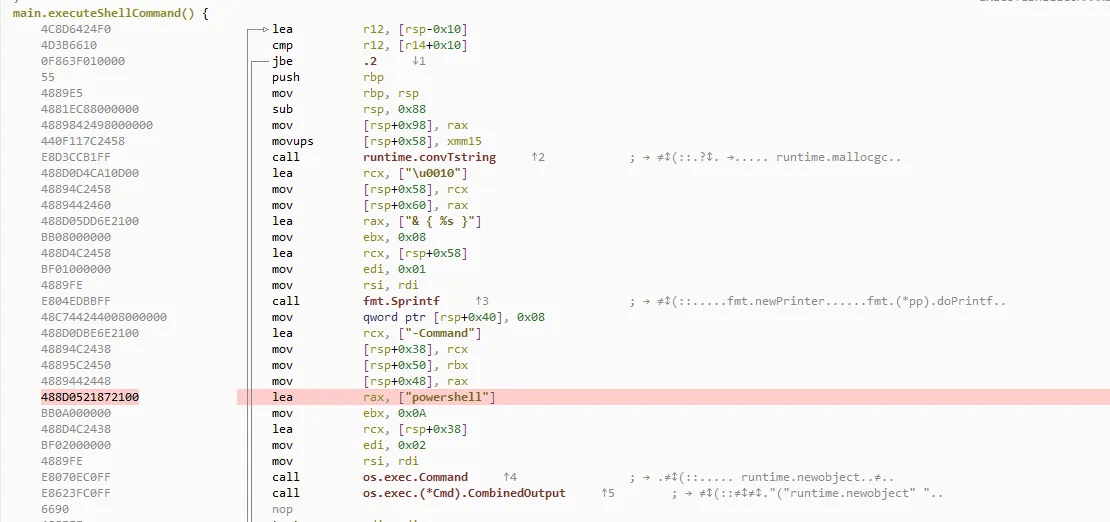
“The implant implements a remote command execution capability main.executeShellCommand similar to PATCHCORD. However, instead of invoking cmd.exe /c, it executes commands through powershell -Command with script block wrapping, suggesting an evolution of the operator’s tooling.”
This one drops the traditional web server entirely and instead uses the Google Sheets API for command and control, creating a dedicated spreadsheet tab for each victim to send and receive instructions. Hiding malicious traffic inside a service as mundane as Google Sheets is a clever way to blend in with normal corporate network traffic that nobody thinks twice about.
The researchers also found a third malware family, HACKERAI C2 Agent, that uses GitHub Gists for the same purpose and shows clear signs of having been built with AI coding assistance. Acronis pointed to leftover debug messages, AI-style code comments, and a redundant double-XOR routine using the same key twice as tells.
“The implant contains code comments and implementation patterns consistent with AI-assisted code generation. Together, these observations suggest that the malware was developed, at least in part, using LLM-assisted coding tools.” the researchers state.
Threat actors are actually using generative AI in practice, not only for some dramatic autonomous hacking campaign, but just as an ordinary coding shortcut.
What really opened the investigation up was an exposed staging server the operator left unsecured. It contained the operator’s entire toolkit laid bare: SuperShell, a Chinese-language command-and-control framework, multiple remote access trojan frameworks, credential-harvesting tools, exploit code for a known OpenSSH vulnerability, and files that appear to follow an iOS call history database format, hinting the group may have also pulled data off mobile devices. Finding a threat actor’s actual staging server is rare, and it’s the kind of mistake that turns a hard-to-attribute campaign into a much clearer picture very quickly.
Acronis links this activity to APT36, also known as Transparent Tribe, a threat group with a documented history of targeting Indian government and defense organizations, though the researchers rate the connection at moderate rather than full confidence. The reasoning holds up: matching credential-harvesting tools previously seen in confirmed APT36 campaigns, a shared C2 framework independently attributed to the same group by other researchers, and a Google Sheets technique closely resembling an earlier documented campaign already linked to the same actor. None of these signals alone would be conclusive, but stacked together they paint a consistent picture rather than a coincidence.
The infrastructure was still live at the time of publication, with domains steadily rotating while the underlying server stayed the same for months. If your organization touches Afghan telecom operations, Indian government systems, or South Asian energy infrastructure, this is exactly the kind of report worth forwarding to whoever handles phishing awareness training, because the lures here are good enough that “just don’t click suspicious links” isn’t much of a defense on its own.
“The PATCHCORD campaign demonstrates an evolving espionage operation targeting telecom, government, defense, and critical infrastructure organizations across South Asia. The discovery of PATCHCORD, SHEETCORD, and HACKERAI C2 Agent highlights the operator’s continued evolution, from a custom C/C++ backdoor to Go-based implants that abuse legitimate cloud services, including Google Sheets and GitHub Gists, for command-and-control.” concludes the report.
“The exposed staging server and related infrastructure provided valuable insight into the operator’s tooling, campaign development, and operational practices, enabling the identification of additional infrastructure and previously undocumented malware.”
Follow me on Twitter: @securityaffairs and Facebook and Mastodon
(SecurityAffairs – hacking, PATCHCORD)
Source: SecurityAffairs
Source Link: https://securityaffairs.com/197266/intelligence/apt36-suspected-in-patchcord-espionage-campaign-using-google-sheets-c2.html