The threat actor linked to recent AI-assisted attacks on South Korean financial institutions was testing infrastructure and assembling attack tools as early as August 2026, weeks before the banking campaign became public, according to new research from Recorded Future’s Insikt Group. Subsequent public reporting indicated that the breaches exposed personal data belonging to at least 68,000 people across at least seven financial institutions.
Insikt Group’s investigation expands the known timeline and capabilities of the actor, tracked as TAG-217. Insikt Group uncovered tools designed to steal cryptocurrency wallet files, gain greater access to Linux systems, and test weaknesses in mobile devices. The findings illustrate the “jagged edge” of AI-enabled attacks: threat actors realizing significant gains while committing basic operational security mistakes. AI helps attackers pursue more targets across more environments, but does not prevent them from making the security mistakes that allowed Recorded Future to uncover preparations and capabilities beyond the reported banking campaign. Those mistakes give defenders opportunities to identify related activity and disrupt operations.
Targeting South Korean Banks
In early October 2026, South Korea’s Financial Services Commission (FSC) disclosed that multiple financial institutions had been hit by cyberattacks. The attacks had compromised different systems and allowed unauthorized access to different data at each victim entity, with one breach exposing the personal information of an outsourced developer and another resulting in the theft of customer data. Industry sources reported that the attacks involved the use of ARTEX, a Chinese-language, open-source AI penetration testing framework. The variety of targets at each financial institution likely demonstrates an advantage of AI over human operators: the ability to opportunistically test for weaknesses at scale until a valuable target is found.
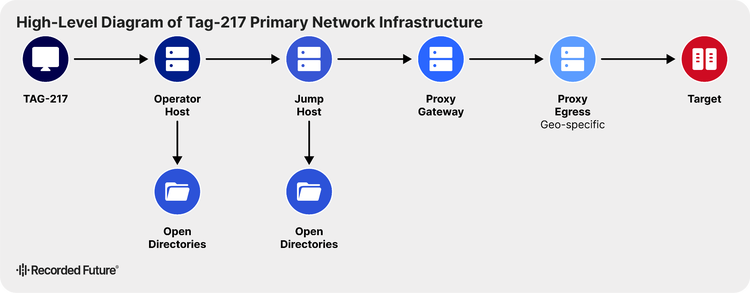
On October 7, 2026, public analysis of the incident identified that the threat actor, suspected to be a Chinese speaker, used several AI tools as part of their campaign, including Claude Code, DeepSeek, Grok, and Zhipu AI. Other reports shared network infrastructure indicators used in the campaign, including a primary server running ARTEX and the use of residential proxies, likely to obfuscate the origin of the activity.
Recorded Future investigated this infrastructure to better understand the actor’s operations and tracked this activity under the designation TAG-217.
Putting Together a More Complete Timeline for TAG-217
Differentiating between agentic and human-operated attacks can be difficult, especially when skilled threat actors use AI to enhance operational effectiveness. Agentic attacks use the same tactics and techniques as human operators, though faster and at scale. In the case of TAG-217, operational security mistakes allowed Insikt Group to piece together how the threat actor used AI tools to amplify their intrusion attempts across multiple environments and to uncover earlier preparations and a broader set of capabilities than public reporting revealed.
Source: RecordedFuture
Source Link: https://www.recordedfuture.com/blog/tag-217-artex-south-korean-banks