Mexico’s Cybersecurity Plan 2025-2030: Turning Ambition Into Defense
Mexico has no shortage of cyber threats. Ransomware attacks are rising, criminal groups are exploiting stolen credentials and financial malware, and state-linked threat actors increasingly view the country’s government agencies, universities, and critical infrastructure as attractive targets. Mexico’s new National Cybersecurity Plan (hereinafter referred to as “Plan�), introduced in December 2025, recognizes many of these risks. However, it remains uncertain as to whether the government can build the institutions needed to address them proactively.
Mexico is ranked as a "Tier 2" nation in the ITU's 2024 Global Cybersecurity Index, placing it alongside Canada, Ecuador, and Uruguay in the upper ranks, trailing the United States (US) and Brazil, which have reached Tier 1 in the Americas. Despite that standing, Mexico is generally perceived by cyber experts as lagging behind international standards in institutional capacity-building, with international cooperation identified as an area requiring growth.
The question of whether the government can build the proper institutions has become more urgent in the aftermath of the FIFA World Cup 2026, which provided a high-profile stress test for Mexico’s digital defenses. With the tournament over and implementation of the government’s 2025-2030 cybersecurity plan beginning in earnest, Mexico faces a major opportunity to improve its cyber posture.
For this reason, the Plan represents a major opportunity for Mexican authorities to bring the country’s cyber readiness to the next level. Although there have been attempts to advance national cybersecurity policy, they have failed to gain traction. With this new Plan, President Claudia Sheinbaum's administration has committed to full implementation over the course of her term, aided by her party's majority control of Congress.
The Plan lays out a six-phase roadmap designed to gradually build Mexico’s cybersecurity capabilities through 2030, with later phases intended to deepen and institutionalize them.
- The 2025 Foundation Phase established a general framework for governance, risk management, incident reporting, and coordination, as well as initial steps to deepen international cooperation, including Mexico’s formal membership in the Latin America and Caribbean Cyber Competence Centre (LAC4) and a cybersecurity Memorandum of Understanding (MOU) with Brazil.
- The 2026 Expansion Phase, now underway, focuses on translating that framework into institutions through the passage of a new General Cybersecurity Law in Mexico, creation of a National Cybersecurity Operations Center, and integration of federal computer security incident response teams (CSIRTs).
- The 2027 Consolidation Phase would establish a National Cyber Range for red team and blue team exercises.
- The 2028 Maturation Phase would incorporate AI into cyber defense and develop a regional response center.
- The 2029 Leadership Phase aims to position Mexico as a cybersecurity services exporter across Latin America and the Caribbean.
- The 2030 Transformation Phase culminates in the establishment of a permanent Cybersecurity Observatory to track incidents, threats, and emerging technologies.
Threat Landscape
In a recent report, Insikt Group assessed Mexico's threat landscape across six persistent categories:
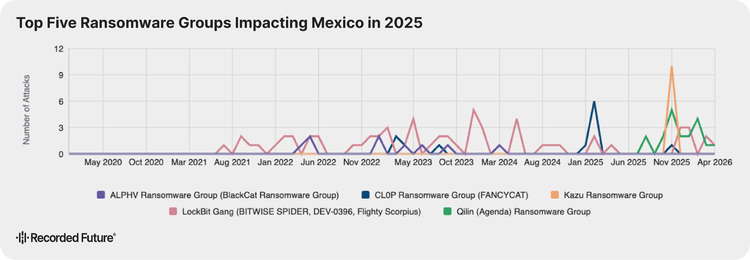
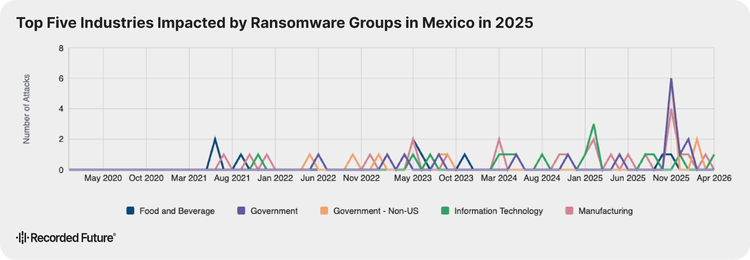
Ransomware is identified as the dominant threat. From January 2020 through April 2026, Insikt Group documented 223 ransomware incidents involving 64 groups and over 100 victims in Mexico. The top ransomware groups were LockBit, Qilin, CL0P, Kazu, and ALPHV (BlackCat), with government, manufacturing, information technology (IT), and food and beverage as the sectors most heavily impacted.
Source: RecordedFuture
Source Link: https://www.recordedfuture.com/blog/mexico-cybersecurity-plan