National Cyber Warfare Foundation (NCWF)login

September 2026 CVE Landscape


0 user ratings
2026-10-13 20:09:06
milo
Blue Team (CND)
In September 2026, Insikt Group® identified 94 high-impact vulnerabilities that should be prioritized for remediation, 59 of which had a Very Critical Recorded Future Risk Score. This represents a 29% increase from last month.

In September 2026, Insikt Group® identified 94 high-impact vulnerabilities to prioritize for remediation, 59 of which had a Very Critical Recorded Future Risk Score. This represents a 29% increase from last month. 43 of these vulnerabilities were surfaced through the US Cybersecurity and Infrastructure Security Agency (CISA)’s Known Exploited Vulnerabilities (KEV) catalog, 37 were reported in open sources and validated by Insikt Group, and 14 were exclusively surfaced through honeypot data.


The 94 vulnerabilities identified affected products from 58 vendors, with Linux and Microsoft together accounting for approximately 13% of the vulnerabilities. The remaining exposures spanned network edge and security management appliances; operating systems (OS) and mobile devices; collaboration, content management, and enterprise platforms; artificial intelligence (AI), developer, and automation tools; and operational technology and industrial systems.


September reporting also highlighted zero-day exploitation of CVE-2026-88771 and CVE-2026-88772 (NetScaler), as well as renewed exploitation of CVE-2026-35273 (PeopleSoft) against unpatched systems.


Quick reference: September 2026 vulnerability table


All 80 vulnerabilities below were actively exploited or operationally weaponized in September 2026. This table does not include the 14 CVEs that were exclusively surfaced through honeypot data, which are available to Recorded Future Intelligence Platform customers via the CVE Monthly report. The table below also provides examples of public PoCs identified by Insikt Group. These PoCs were not tested for accuracy or efficacy. Vulnerability management teams should exercise caution and verify the validity of PoCs before testing.


#

Vulnerability

Risk
Score

Vendor/Product

KEV

RCE

PoC


1

CVE-2019-0708

99

Microsoft Remote Desktop Services


✓


2

CVE-2021-38003

99

Google Chrome


✓


3

CVE-2021-44228

99

Apache Log4j2


✓


4

CVE-2022-0847

99

Linux kernel


5

CVE-2022-22965

99

Spring Framework


✓


6

CVE-2025-25249

99

Fortinet FortiOS and FortiSwitchManager

✓

✓


7

CVE-2025-39682

99

Linux kernel (Siemens SIMATIC CN 4100)

✓


8

CVE-2025-39964

99

Linux kernel (Siemens SIPLUS S7-1500 CPU 1518-4 PN/DP MFP)

✓


9

CVE-2026-19490

99

Citrix NetScaler ADC and Gateway

✓


10

CVE-2026-20079

99

Cisco Secure FMC and SCC Firewall Management

✓

✓


11

CVE-2026-39987

99

Marimo


✓


12

CVE-2026-42016

99

JFrog Artifactory

✓


13

CVE-2026-42018

99

JFrog Artifactory

✓


14

CVE-2026-48710

99

Starlette and affected Red Hat products

✓


15

CVE-2026-49869

99

Kestra OSS

✓

✓


16

CVE-2026-53266

99

Linux kernel

✓


17

CVE-2026-5430

99

WSO2 Universal Gateway, Traffic Manager, and API Control Plane

✓


18

CVE-2026-58704

99

Google Pixel (modem)

✓


19

CVE-2026-60137

99

WordPress Core


20

CVE-2026-63030

99

WordPress Core


✓


21

CVE-2026-65660

99

Microsoft SharePoint Server

✓

✓


22

CVE-2026-67277

99

MikroTik RouterOS

✓


23

CVE-2026-67279

99

MikroTik RouterOS

✓


24

CVE-2026-71362

99

Adobe Commerce and Magento Open Source

✓


25

CVE-2026-7273

99

Zyxel GS1900 series switches

✓

✓


26

CVE-2026-75650

99

Adobe Commerce and Magento Open Source

✓

✓


27

CVE-2026-76460

99

Cisco ISE and ISE-PIC

✓


28

CVE-2026-76461

99

Cisco Secure Email Gateway

✓

✓


29

CVE-2026-76504

99

Cisco Catalyst SD-WAN Manager

✓


30

CVE-2026-81963

99

Microsoft Windows Update Stack

✓


31

CVE-2026-83548

99

SonicWall SMA1000

✓


32

CVE-2026-84869

99

ConnectWise ScreenConnect

✓

✓


33

CVE-2026-85102

99

Check Point Security Gateway and Spark Firewall

✓

✓


34

CVE-2026-85706

99

GitLab CE/EE

✓


35

CVE-2026-85880

99

Microsoft Windows ALPC

✓


36

CVE-2026-86060

99

MikroTik RouterOS

✓


37

CVE-2026-86218

99

N-able N-central

✓

✓


38

CVE-2026-86950

99

Apple iOS, iPadOS, and macOS

✓

✓


39

CVE-2026-87491

99

Google Chrome (V8)

✓

✓


40

CVE-2026-87886

99

Acronis Backup integrations for cPanel & WHM, Plesk, and DirectAdmin

✓


41

CVE-2026-87902

99

WordPress Core

✓

✓


42

CVE-2026-88771

99

Citrix NetScaler ADC and Gateway

✓

✓


43

CVE-2026-88772

99

Citrix NetScaler ADC and Gateway

✓

✓


44

CVE-2026-93616

99

Check Point Management Server

✓

✓


45

CVE-2026-93952

99

Arista VeloCloud Orchestrator

✓


46

CVE-2026-94127

99

F5 BIG-IP APM

✓

✓


47

CVE-2014-6271

89

GNU Bash


✓


48

CVE-2020-1938

89

Apache Tomcat


✓


49

CVE-2021-43798

89

Grafana


50

CVE-2024-21762

89

Fortinet FortiProxy and FortiOS


✓


51

CVE-2026-20316

89

Cisco Secure Firewall Management Center (FMC)


52

CVE-2026-34908

89

Ubiquiti UniFi OS


53

CVE-2026-34909

89

Ubiquiti UniFi OS


54

CVE-2026-34910

89

Ubiquiti UniFi OS


✓


55

CVE-2026-35273

89

Oracle PeopleSoft Enterprise PeopleTools


✓


56

CVE-2026-59822

89

LiteLLM

✓


57

CVE-2026-60004

89

Gitea


✓


58

CVE-2026-81578

89

PaperCut NG/MF


59

CVE-2026-82078

89

PaperCut NG/MF


60

CVE-2026-82329

89

JFrog Artifactory

✓


61

CVE-2026-83549

89

SonicWall SMA1000

✓

✓


62

CVE-2026-85046

89

Google Chromium V8 and Chrome

✓

✓


63

CVE-2026-89026

89

Issabel Framework


✓


64

CVE-2026-9586

89

Sangoma Switchvox SMB Edition

✓

✓


65

CVE-2023-54391

87

Proxmox Virtual Environment (VE)


66

CVE-2026-56271

84

Flowise


67

CVE-2026-86124

83

HKUDS AutoAgent


✓


68

CVE-2026-67394

82

WebPros Plesk


✓


69

CVE-2016-4437

79

Apache Shiro


✓


70

CVE-2021-29441

79

Alibaba Nacos


71

CVE-2024-4956

79

Sonatype Nexus Repository


72

CVE-2026-14894

79

Super Forms for WordPress


✓


73

CVE-2026-27540

79

WooCommerce Wholesale Lead Capture for WordPress


✓


74

CVE-2026-32475

79

Elementor Pro for WordPress


✓


75

CVE-2026-51990

79

Sogou Input Method


✓


76

CVE-2026-67276

79

MikroTik RouterOS


77

CVE-2026-54569

73

Senaite


✓


78

CVE-2026-58046

71

WebPros Plesk


79

CVE-2026-64637

71

WebPros Plesk


80

CVE-2026-79756

71

Nuclio


✓


Table 1: List of vulnerabilities that were actively exploited in September 2026 based on Recorded Future data (excluding honeypot-sourced CVEs).


Key trends: September 2026


  • September reporting linked NightEagle and UNC3569 to GhostContainer and GRAYRABBIT deployments, while Cisco FMC exploitation by three threat clusters led to credential theft, Cyclops Blink deployment, and Qilin ransomware.

  • A suspected Chinese-speaking actor used a SecFlow-based environment with Claude-, Qwen-, and DeepSeek-backed workers, and a suspected Russian-speaking actor used hundreds of AI agents to compromise at least 440 PaperCut NG/MF instances associated with 395 organizations.

  • 47 of the 94 vulnerabilities enabled remote code execution (RCE). Network-edge and security-management products were the most affected product type. Apache and Google represented the largest share of vendors, with three RCE vulnerabilities each.

  • Insikt Group identified public proof-of-concept (PoC) exploits or scanners for 75 of the 94 vulnerabilities identified in September.

  • The most common weakness class was CWE-306 (Missing Authentication for Critical Function), with seven vulnerabilities, followed by CWE-22 (Path Traversal), with six. CWE-78 (OS Command Injection), CWE-89 (SQL Injection), and CWE-94 (Code Injection) each affected five vulnerabilities.

  • Eight of the 94 vulnerabilities were at least five years old, and the oldest was approximately 12 years old.


Trend analysis


AI-assisted campaigns combine older flaws with post-compromise tooling


Insikt Group detailed a suspected Chinese-speaking actor using a SecFlow-based operations environment with Claude-, Qwen-, and DeepSeek-backed workers to support reconnaissance, exploitation, post-exploitation, and collection across Asian targets. The threat actor tested or staged workflows for CVE-2014-6271, CVE-2020-1938, CVE-2022-22965, CVE-2016-4437, CVE-2021-43798, CVE-2024-4956, CVE-2021-29441, and CVE-2021-44228. The workflow routed candidate findings to vulnerability-specific playbooks, but not every attempt produced confirmed access.


A separate September report described a suspected Russian-speaking threat actor using hundreds of AI agents in a campaign targeting PaperCut NG/MF. The campaign exploited CVE-2026-81578 and CVE-2026-82078, compromising at least 440 instances associated with 395 organizations.
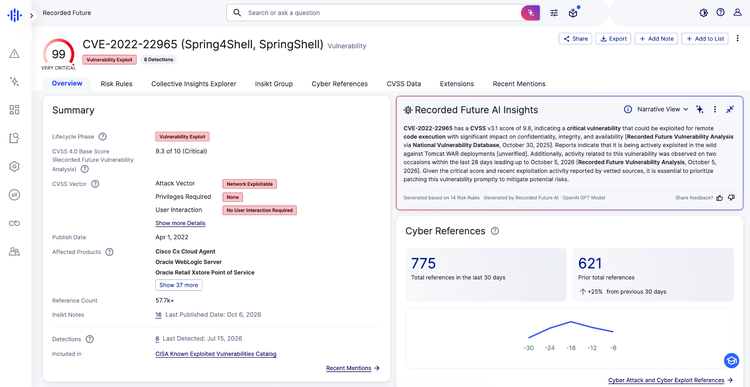


Risk Rules history on the Vulnerability Intelligence Card® for CVE-2022-22965 in Recorded Future


Figure 1: Risk Rules history on the Vulnerability Intelligence Card® for CVE-2022-22965 in Recorded Future (Source: Recorded Future)


Source: RecordedFuture
Source Link: https://www.recordedfuture.com/blog/september-2026-cve-landscape


Comments
new comment
Nobody has commented yet. Will you be the first?
 
Forum
Blue Team (CND)


Copyright 2012 through 2026 - National Cyber Warfare Foundation - All rights reserved worldwide.