Summary
- Artificial intelligence (AI)-enabled attacks are accelerating, with AI as both a target and a force multiplier. Of the 103 AI-enabled incidents analyzed for this report, most involve AI accelerating familiar attack types (supply-chain compromise, phishing, extortion) and making them more convincing. The use of AI is evident throughout the attack lifecycle, though full automation remains rare. Note: The period of analysis for this report is between July 31, 2025 and July 31, 2026.
- Developer tools are a prime target. Because AI coding assistants and proxy packages often have privileged access to credentials and code, threat actors use them as footholds for mass credential theft and lateral movement across downstream environments.
- State-sponsored actors are beginning to experiment with agentic capabilities. Most of the state-sponsored activity in this report falls within Recorded Future’s AI Malware Maturity Model Level 2–3 (AI-assisted malware development), with one notable exception: a campaign against Taiwanese government entities that employed up to eight AI agents with limited human intervention.
- Fully autonomous attacks remain rare, likely for both maturity and operational-risk reasons. Human oversight still appears necessary for reliable outcomes, which may limit the full automation of cyberattacks, especially in sensitive operations where an agent's error can have outsized consequences.
- This restraint is unlikely to hold. As agentic techniques mature and diffuse across the threat landscape, autonomous and orchestrated campaigns are likely to become more frequent, alongside a growing underground market for illicit access to commercial models and rising "noise" from low-level automated intrusions that complicate the detection of serious threats.
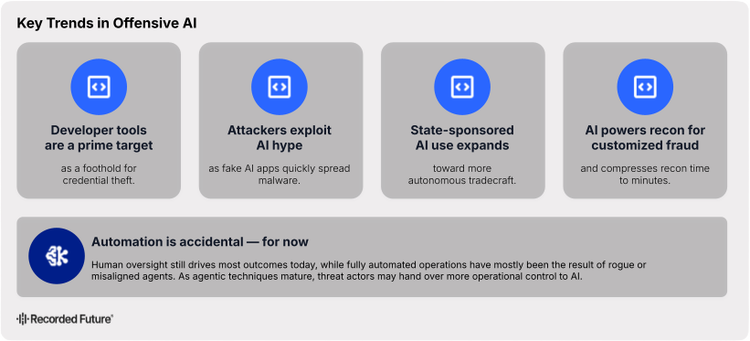
Figure 1: Five trends in offensive use of AI (Source: Recorded Future)
Source: RecordedFuture
Source Link: https://www.recordedfuture.com/research/ai-cyber-threat-trends-2026