Executive Summary
H1 2026 activity showed a continued adversary preference for abusing legitimate tools, trusted platforms, and routine workflows already present in enterprise and consumer environments. Threat actors used exposed software, developer tools, remote access utilities, payment workflows, and third-party services to gain access, steal credentials, move laterally, and monetize intrusions while blending into expected activity. This emphasis on evasion through normalcy rather than technical novelty increases the risk that malicious activity will progress through approved tools and trusted services before defenders recognize it, reinforcing the need for stronger exposure management, identity and credential governance, behavioral detection, developer-environment security, backup resilience, mobile fraud monitoring, and third-party oversight.
AI-enabled cyberattacks became more visible in H1 2026, but remained mostly additive to established intrusion tradecraft. In the vulnerability ecosystem, AI-assisted research increased the volume of vulnerability reports, which, moving forward, could further compress remediation timelines by accelerating exploit-path analysis and lowering exploit-development costs for skilled operators. In malware activity, observed AI-enabled capabilities largely aligned with lower-to-mid-level stages of Recorded Future’s AI Malware Maturity Model (AIM3), where AI supported discrete functions such as persistence, user interface (UI) interaction, malware development, and delivery rather than fully autonomous operations.
Vulnerability exploitation broadened across enterprise operating systems, application frameworks, and network and security management products. Insikt Group identified 215 actively exploited common vulnerabilities and exposures (CVEs), and the most consequential cases combined network reachability, few access prerequisites, and code execution. Campaign reporting also showed that threat actors reused established post-exploitation playbooks across both newly disclosed and long-standing vulnerabilities, making exposure and impact more informative indicators of operational risk than vendor ranking or severity score alone. Across phishing and malware-delivery operations, threat actors repeatedly relied on familiar execution, obfuscation, discovery, and payload-transfer techniques rather than novel capabilities. Supply-chain compromises targeted package managers and developer environments, including AI-enabled tooling, where compromised credentials, trusted integrations, and software distribution channels enabled propagation into downstream cloud and software ecosystems. Other prominent activities included mobile malware enabling payment fraud through Near Field Communication (NFC) abuse and early AI-assisted workflows, as well as Magecart campaigns leveraging trusted third-party services and checkout manipulation.
The common risk across these threats is that malicious activity can progress through legitimate tools, trusted services, and routine workflows before defenders recognize it as part of a broader intrusion. Defenders should therefore prioritize vulnerabilities that can be exploited remotely or enable code execution, focus detection on suspicious sequences of behavior rather than isolated events, and strengthen controls protecting developer credentials, backup infrastructure, company-owned mobile devices, and payment environments.
Key Findings
- Insikt Group identified 215 actively exploited CVEs in H1 2026, up 34% from 161 in H1 2025. 142 of the 146 vulnerabilities that could be exploited without prior authentication were also network-accessible, and 60 of the 82 remote code execution (RCE) vulnerabilities combined network access with no authentication requirement.
- Similar to H1 2025, Recorded Future Malware Intelligence data showed the continued prominence of remote access trojans (RATs) throughout H1 2026. RATs led Insikt Group malware reporting, and Recorded Future Malware Intelligence submissions identified AsyncRAT as the top submitted malware family by total unique hashes and command-and-control (C2) configurations. AsyncRAT, Cobalt Strike, XWorm, Stealc, and REMCOS RAT remained in the top ten across H1 2025 and H1 2026.
- H1 2026 AI-enabled malware activity was concentrated in AIM3 Levels 1 to 3, with threat actors using AI to augment existing malware and intrusion workflows rather than conduct fully autonomous attacks.
- Ransomware operators continued to refine payload capabilities while relying on established intrusion methods, including ClickFix-style social engineering; exploitation of public-facing applications; abuse of legitimate tools such as s5cmd, PsExec, and AnyDesk; and techniques intended to reduce victims’ recovery options.
- Android NFC malware was the most notable mobile malware trend in H1 2026, with families such as NFCShare and NGate abusing device NFC functionality to steal payment card data, relay contactless transactions, and facilitate ATM cash-outs.
AI-Enabled Cyberattacks
AI-enabled cyber threats became more visible in H1 2026, but the available evidence indicates that most observed activity still augmented existing tradecraft rather than replacing it with fully autonomous operations.
In the vulnerability ecosystem, the release of Anthropic’s Claude Mythos Preview reinforced the growing relevance of frontier models to offensive and defensive security research. Broader vulnerability reporting also increased following the model’s release under Project Glasswing: June National Vulnerability Database (NVD) disclosures were 43% above the previous six-month average, while Mozilla reported that Mythos Preview identified 271 vulnerabilities that it fixed in Firefox 150, compared with 22 security flaws fixed following its earlier testing with Claude Opus 4.6. Vendors, AI developers, and bug-bounty platforms like Microsoft, Anthropic, and HackerOne have also reported rising vulnerability discovery or submission volumes alongside broader adoption of AI-assisted research, adding pressure to validation, disclosure, and remediation workflows.
Despite the increase in vulnerability reports, AI has not changed the fundamentals of vulnerability management: Attackers still need to identify, validate, weaponize, and operationalize vulnerabilities that offer reach, reliability, and return on investment. This means that only a small proportion of newly discovered vulnerabilities are likely to be a threat.
Nonetheless, AI-enabled vulnerability research can still increase defender workload in three ways: It can produce more credible vulnerability reports that require triage; reduce the time available to mitigate exploitable vulnerabilities by accelerating exploit-path analysis and weaponization; and lower the cost of exploit development by helping skilled operators produce proof-of-concept (PoC) code, test attack paths, and iterate toward weaponizable exploits more quickly. For defenders, the near-term issue is therefore not a sudden flood of fully autonomous exploitation, but a narrower window to determine which vulnerabilities matter most and remediate them before threat actors operationalize them. Additionally, early H2 2026 reporting on the July 2026 Hugging Face incident demonstrated that autonomous agents can perform discovery, validation, weaponization, and operationalization with limited human intervention. Defenders should prepare by automating vulnerability enrichment, prioritization, and mitigation to reduce the gap between machine-speed attack development and defensive response.
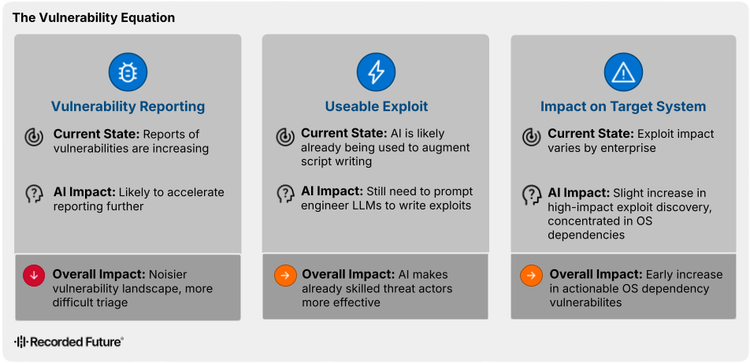
Malware reporting in H1 2026 showed more direct experimentation with AI-enabled capabilities compared to H1 2025. ESET identified PromptSpy as the first known Android malware to use generative AI (GenAI), using Google’s Gemini to interpret on-screen UI elements and generate step-by-step instructions to improve persistence across device layouts. Reporting on CANFAIL also showed threat actors using LLM-generated decoy logic or AI-assisted development artifacts to complicate analysis and facilitate malware delivery against Ukrainian organizations. These examples suggest that threat actors are testing AI in ways that can solve narrow operational problems: adapting to user interfaces, generating code or decoy logic, improving obfuscation, and supporting analyst confusion.
Threat actors also used AI-related products and ecosystems as delivery mechanisms. In February 2026, VirusTotal reported malicious OpenClaw skills disguised as useful automation for a local AI agent ecosystem, while Malwarebytes reported fake OpenClaw installers hosted on GitHub and surfaced through search results to deliver infostealers and proxy malware. This activity shows that attackers are exploiting user interest in AI tools in the same way they have historically abused popular software brands, distributing trojanized installers, malicious extensions, fake repositories, and dependency-based payloads through otherwise familiar channels.
As of H1 2026, Insikt Group assesses that most observed AI-enabled malware activity aligns with the low-to-mid-level stages of Recorded Future’s AI Malware Maturity Model (AIM3), specifically experimentation, adoption, and optimization, rather than fully autonomous AI-driven malware operations. Per the Recorded Future’s AIM3 framework, most publicly observed “AI malware� remains concentrated in Levels 1 to 3, where AI supports discrete operational tasks such as UI interpretation, persistence guidance, transaction timing, or operator guidance. Therefore, the near-term risk is not primarily self-directed malware operating independently, but rather the use of AI to make existing intrusion workflows faster, more convincing, more adaptive, and harder to analyze. Defenders should not expect a single control, model, or endpoint detection layer to reliably identify all AI-enabled malware activity. Instead, organizations should use defense-in-depth controls that can detect or disrupt different parts of the attack chain, including endpoint detection for script or installer activity tied to suspicious AI-themed downloads, extensions, repositories, or packages, mobile device management for accessibility service abuse and automated UI interaction, and restrictions on unapproved AI tools and installers.
Vulnerability Exploitation Trends
Key Takeaways
- Network reachability and low access requirements compounded risk, as 142 of the 215 exploited CVEs were network-accessible and could be exploited without prior authentication; 60 of those also enabled RCE, while public exploits were available for 66 (31%).
- Defenders faced both newly exploited flaws and persistent patch backlogs, as 162 CVEs were disclosed in 2025 or 2026, 53 predated 2025, and seventeen were dated from 2020 or earlier.
- Threat actors reused post-exploitation playbooks across different initial vulnerabilities; StrikeShark applied the same six-tool stack across thirteen CVEs, while Storm-1175 linked credential theft, remote execution, data transfer, and ransomware tooling across ten. More broadly, stealware was the most common malware category, followed by offensive security tools, backdoors, remote access trojans, and ransomware.
Microsoft Remains the Leading Vendor for Exploited Vulnerabilities
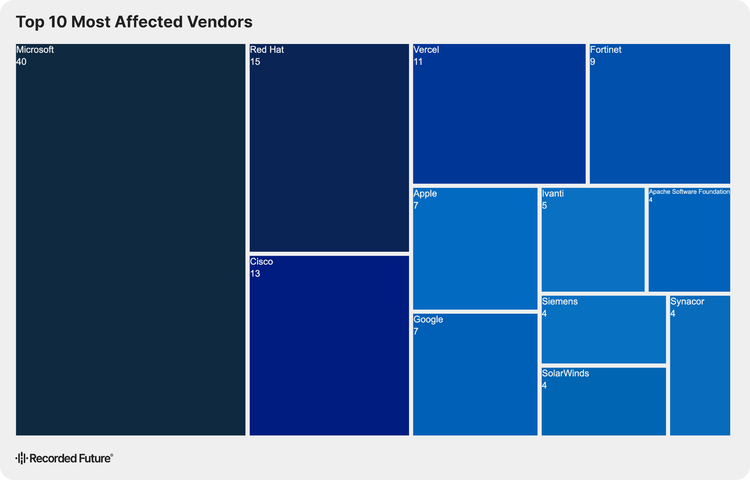
In H1 2026, Insikt Group identified 215 actively exploited vulnerabilities, up 34% from 161 in H1 2025. From January to June, the number of exploited vulnerabilities increased by an average of seven vulnerabilities per month. Microsoft remained the vendor most frequently associated with exploited vulnerabilities, accounting for 40 unique CVEs, up from 28 in H1 2025, a 43% year-over-year increase. Red Hat ranked second with fifteen CVEs, Cisco third with thirteen, Vercel fourth with eleven, and Fortinet fifth with nine. By comparison, H1 2025’s top affected vendors after Microsoft were Apple with eight CVEs, Ivanti with seven, Linux with six, and SonicWall, Google, Fortinet, and Craft CMS with four each.
The exploited vulnerabilities affected products from 98 vendors, 67 of which were associated with only one CVE. This indicates that exploitation was not confined to the most frequently affected vendors. For defenders, this supports maintaining risk-based remediation across the full software inventory, including less common products that may receive less monitoring or slower patching than widely deployed enterprise platforms.
At the product-family level, Windows and Windows Server accounted for the largest H1 2026 concentration, with twenty unique CVEs, followed by Red Hat Enterprise Linux with thirteen, Vercel Next.js with eleven, Cisco Catalyst SD-WAN Manager with eight, and Apple iOS and iPadOS with seven. While Microsoft exploitation remained prominent, H1 2026 activity also increasingly involved enterprise Linux, application frameworks, and network management products. Several vendors’ vulnerabilities were also driven by concentrated exploitation of one product family rather than uniform interest across the vendor’s portfolio: all eleven Vercel CVEs centered on Next.js, eight of Cisco’s thirteen affected Catalyst SD-WAN, and thirteen of Red Hat’s fifteen affected Red Hat Enterprise Linux.
Source: RecordedFuture
Source Link: https://www.recordedfuture.com/research/h1-2026-malware-vulnerability-trends