In July 2026, Insikt Group® identified 85 high-impact vulnerabilities that should be prioritized for remediation, 36 of which had a Very Critical Recorded Future Risk Score. This represents a 44% increase from last month.
In July 2026, Insikt Group® identified 85 high-impact vulnerabilities that should be prioritized for remediation, 36 of which had a Very Critical Recorded Future Risk Score. This represents a 44% increase from last month. 26 of these vulnerabilities were surfaced through the US Cybersecurity and Infrastructure Security Agency (CISA)’s Known Exploited Vulnerabilities (KEV) catalog, 55 were reported by vendors, and four were primarily surfaced through honeypot data.
The 85 vulnerabilities in this report affected products from 61 vendors, with Microsoft accounting for approximately 12% of the vulnerabilities. The remaining exposure was concentrated across a range of enterprise software, security products, network infrastructure, developer tooling, and cloud platform vendors.
Insikt Group previously created a Nuclei template to detect the Langflow vulnerability (CVE-2025-3248) featured in this report. These are available to Recorded Future customers via the Recorded Future Intelligence Platform.
Quick reference: July 2026 Vulnerability Table
All 81 vulnerabilities below were actively exploited or operationally weaponized in July 2026. This table does not include the four CVEs that were primarily surfaced through our honeypot data, which are available to Recorded Future Intelligence Platform customers via the CVE Monthly report. The table below also provides examples of public PoCs identified by Insikt Group. These PoCs were not tested for accuracy or efficacy. Vulnerability management teams should exercise caution and verify the validity of PoCs before testing.
#
Vulnerability
Risk
Score
Vendor/Product
KEV
Analysis
RCE
PoC
1
CVE-2008-4128
99
Cisco IOS
✓
✓
2
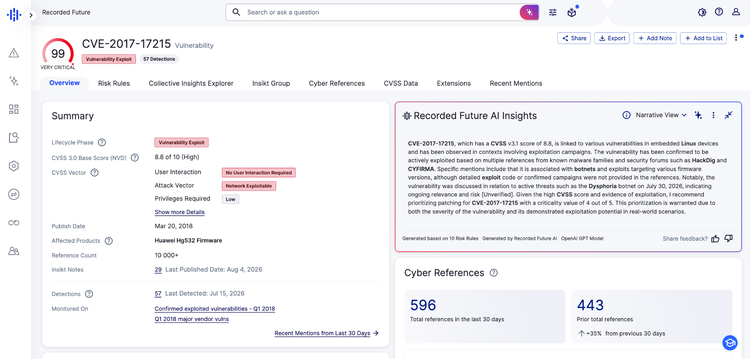
CVE-2017-17215
99
Huawei HG532
✓
✓
3
CVE-2018-0802
99
Microsoft Office Equation Editor
✓
✓
4
CVE-2021-4034
99
Polkit
✓
5
CVE-2021-27137
99
DD-WRT
✓
✓
6
CVE-2023-4346
99
KNX Association KNX Protocol Connection Authorization Option 1
✓
7
CVE-2025-55182
99
Meta React Server Components
✓
✓
8
CVE-2025-68686
99
Fortinet FortiOS
✓
9
CVE-2026-0770
99
Langflow
✓
✓
10
CVE-2026-15409
99
SonicWall SMA1000 Appliances
✓
11
CVE-2026-15410
99
SonicWall SMA1000 Appliances
✓
✓
12
CVE-2026-16232
99
Check Point SmartConsole
✓
13
CVE-2026-16812
99
Arista VeloCloud Orchestrator
✓
14
CVE-2026-20316
99
Cisco Secure Firewall Management Center (FMC)
✓
15
CVE-2026-25089
99
Fortinet FortiSandbox
✓
✓
16
CVE-2026-34486
99
Apache Tomcat
✓
17
CVE-2026-39808
99
Fortinet FortiSandbox
✓
✓
18
CVE-2026-39987
99
Marimo
✓
✓
19
CVE-2026-46817
99
Oracle E-Business Suite
✓
20
CVE-2026-48282
99
Adobe ColdFusion
✓
✓
21
CVE-2026-48907
99
JoomlaContentEditor.net Joomla Content Editor (JCE)
✓
✓
22
CVE-2026-48908
99
JoomShaper SP Page Builder
✓
✓
23
CVE-2026-48939
99
iCagenda
✓
✓
24
CVE-2026-50522
99
Microsoft SharePoint
✓
✓
25
CVE-2026-55255
99
Langflow
✓
26
CVE-2026-56155
99
Microsoft Active Directory Federation Services
✓
27
CVE-2026-56164
99
Microsoft SharePoint Server
✓
28
CVE-2026-56290
99
Joomlack Page Builder
✓
✓
29
CVE-2026-56291
99
Balbooa Forms
✓
✓
30
CVE-2026-58644
99
Microsoft SharePoint
✓
✓
31
CVE-2026-60137
99
WordPress Core
✓
32
CVE-2026-63030
99
WordPress Core
✓
✓
33
CVE-2021-3156
89
Sudo
✓
34
CVE-2021-29441
89
Alibaba Nacos
✓
35
CVE-2025-6389
89
Sneeit Framework
✓
✓
36
CVE-2025-9491
89
Microsoft Windows
✓
✓
37
CVE-2025-32432
89
Craft CMS
✓
✓
38
CVE-2025-3248
89
Langflow
✓
✓
39
CVE-2025-34152
89
Shenzhen Aitemi M300 Wi-Fi Repeater
✓
✓
40
CVE-2025-49113
89
Roundcube Webmail
✓
✓
41
CVE-2025-66376
89
Zimbra Collaboration
✓
42
CVE-2026-0257
89
Palo Alto Networks PAN-OS and Prisma Access
✓
43
CVE-2026-0740
89
SaturdayDrive Ninja Forms - File Uploads
✓
✓
44
CVE-2026-3055
89
NetScaler ADC and Gateway
✓
45
CVE-2026-6875
89
ServiceNow AI Platform
✓
✓
46
CVE-2026-12569
89
PTC Windchill PDMLink and FlexPLM
✓
✓
47
CVE-2026-29014
89
MetInfo CMS
✓
✓
48
CVE-2026-42897
89
Microsoft Exchange Server 2016 CU23 and Subscription Edition RTM
✓
49
CVE-2026-45659
89
Microsoft SharePoint Server
✓
✓
50
CVE-2026-31843
87
goodoneuz pay-uz
✓
✓
51
CVE-2013-3307
79
Linksys E1000, E1200, and E3200
✓
✓
52
CVE-2016-20016
79
MVPower TV-7104HE and TV-7108HE DVRs
✓
✓
53
CVE-2017-5259
79
Cambium Networks cnPilot
✓
✓
54
CVE-2017-7269
79
Microsoft IIS
✓
✓
55
CVE-2018-11511
79
ASUSTOR ADM Photo Gallery
✓
56
CVE-2018-14558
79
Tenda AC9, AC10, and AC7 firmware
✓
✓
57
CVE-2020-8515
79
DrayTek Vigor2960, Vigor300B, and Vigor3900 firmware
✓
✓
58
CVE-2020-22653
79
Ruckus APs, SmartZone, and ZoneDirector
✓
59
CVE-2020-22658
79
Ruckus APs, SmartZone, and ZoneDirector
✓
60
CVE-2020-25499
79
TOTOLINK A3002RU firmware
✓
✓
61
CVE-2020-36847
79
Eemitch Simple File List
✓
✓
62
CVE-2021-31755
79
Tenda AC11 firmware
✓
✓
63
CVE-2021-32305
79
WebSVN
✓
✓
64
CVE-2022-35733
79
UNIMO Technology UDR-JA1004, UDR-JA1008, and UDR-JA1016 digital video recorders
✓
✓
65
CVE-2023-25717
79
Ruckus Wireless Admin
✓
✓
66
CVE-2024-42009
79
RoundCube Webmail
✓
67
CVE-2025-9528
79
Linksys E1700
✓
✓
68
CVE-2025-12057
79
WavePlayer
✓
✓
69
CVE-2025-12352
79
Gravity Forms
✓
✓
70
CVE-2025-13486
79
Hwk-Fr Advanced Custom Fields: Extended
✓
✓
71
CVE-2025-28137
79
TOTOLINK A810R firmware
✓
✓
72
CVE-2026-1357
79
WPvivid Backup, Migration & Staging
✓
✓
73
CVE-2026-3395
79
MaxSite CMS
✓
✓
74
CVE-2026-3844
79
Cloudways Breeze Cache
✓
✓
75
CVE-2026-16723
79
Alibaba Fastjson
✓
✓
76
CVE-2026-29059
79
Windmill
✓
77
CVE-2026-33824
79
Microsoft Windows IKE Extension
✓
✓
78
CVE-2021-24139
78
Photo Gallery by 10Web
✓
79
CVE-2025-7852
78
Iqonic Design WPBookit
✓
✓
80
CVE-2026-1969
72
ThemeREX Addons WordPress plugin
✓
81
CVE-2025-7443
71
BerqWP Automated Page Speed Optimization
✓
✓
Table 1: List of vulnerabilities that were actively exploited in July, 2026 based on Recorded Future data (excluding honeypot-sourced CVEs).
Key trends: July 2026
- In July 2026, the Dysphoria botnet was used to exploit known IoT and embedded-device flaws to build DDoS and relay infrastructure; Cloud Atlas abused Microsoft Equation Editor to deliver CloudAtlasGo; Armored Likho used a malicious Windows shortcut to deploy BusySnake Stealer; and JADEPUFFER and Cl0p targeted exposed AI and product-lifecycle platforms for encryption, data theft, and extortion.
- 57 of the 85 vulnerabilities enabled remote code execution (RCE), including flaws affecting Microsoft, Fortinet, Langflow, ServiceNow, WordPress, and Joomla ecosystems, internet-facing security appliances, and embedded network devices.
- We identified public proof-of-concept (PoC) exploits and scanners for 60 of the 85 vulnerabilities in this report.
- The most commonly observed weakness classes were CWE-78 (OS Command Injection), CWE-434 (Unrestricted Upload of File with Dangerous Type), CWE-94 (Code Injection), and CWE-502 (Deserialization of Untrusted Data).
- 14 of the 85 vulnerabilities in this month’s table are at least 5 years old, with the oldest approximately 18 years old, reinforcing how threat actors continue to exploit long-known weaknesses in environments where patching has lagged. Additionally, the fastest observed time from a vulnerability’s public disclosure to reported exploitation was less than one day.
Trend analysis: Malware-Linked Exploitation Spans IoT, Email, and Enterprise Applications
An Insikt Group® TTP Instance on the Dysphoria botnet linked CVE-2013-3307, CVE-2016-20016, CVE-2017-17215, CVE-2017-5259, CVE-2018-14558, CVE-2020-25499, CVE-2020-8515, CVE-2022-35733, CVE-2025-28137, CVE-2025-34152, CVE-2025-55182, CVE-2025-9528 to the exploitation of routers, gateways, cameras, repeaters, and other embedded Linux devices. Dysphoria combined known RCE flaws with weak Telnet and Secure Shell credentials to enroll compromised systems into DDoS and relay infrastructure.
Source: RecordedFuture
Source Link:
https://www.recordedfuture.com/blog/july-2026-cve-landscape