Malware is abusing car infotainment updates to install proxy software, turning Android head units into nodes for the BADBOX network.
Kaspersky researchers found something in June 2026 that made them stop and look twice: an Android app with no interface at all, installed like any ordinary app but making zero effort to disguise itself as legitimate. Their report documents the first known malware infection targeting car head units, the Android-based infotainment and control systems built into many modern vehicles, spread through the vehicle’s own official update mechanism.
Head units run Android for practical reasons, since manufacturers can build on existing source code and add their own custom system apps during production. That flexibility cuts both ways. Because head units are just Android devices under the hood, most apps built for smartphones can technically run on them too, including malware, even though something like a banking trojan would be wasted effort on a device nobody uses for mobile banking.
Kaspersky researchers found something unusual in June 2026: an Android app with no visible interface that was installed like a normal app but did not try to look legitimate. Their report describes what they say is the first known malware infection targeting car head units, Android-based systems used for infotainment and vehicle controls, delivered through the car’s official update system.
“We identified new Android malware: a multi-stage downloader whose ultimate purpose is ad fraud and creation of a proxy botnet.” reads the report published by Kaspersky. “The malware spread through the built-in updaters of Android-based automotive head unit firmware. This is the first documented case of malware found on a car head unit with an infection chain specific to that type of device.”
Car head units often use Android because it is flexible and lets manufacturers add their own software. But this also creates a security risk. Since these systems are basically Android devices, many apps designed for smartphones can also run on them, including malware.
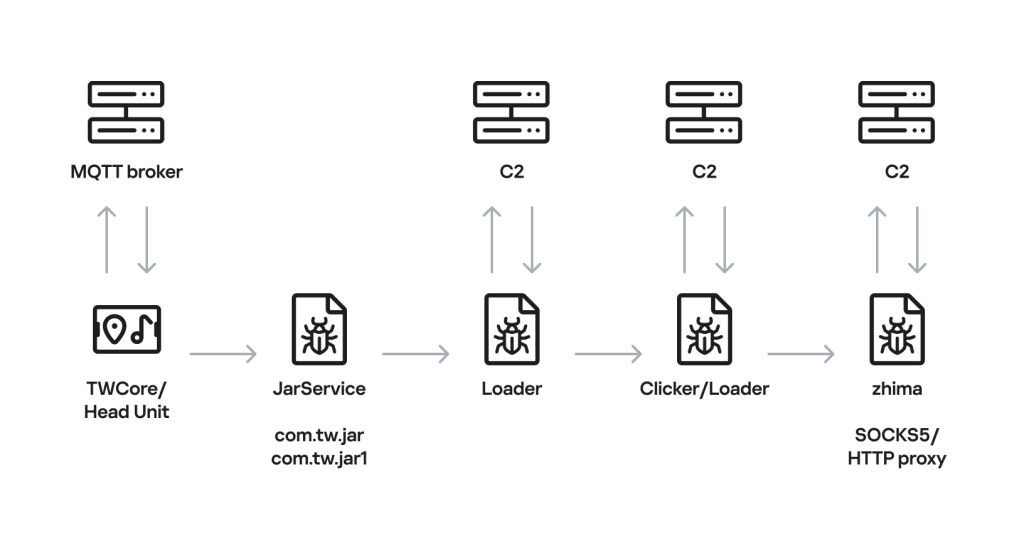
The infection chain here starts inside TWCore, a completely legitimate system app responsible for analytics and firmware updates on DoFun head units. An MQTT message broker sends TWCore instructions about which APK files to download and install, and a specific configuration flag called installNotExists controls whether the app checks if something is already installed before pushing it.
“TWCore only checks whether an app is already installed on the device when installNotExists = false
The APK file is downloaded to
which means setting that flag the other way turns a routine update channel into a silent installation pipeline for anything the attackers want to push.
What gets installed through that channel is a small dropper called JarService, carrying zero user interface and doing nothing but decrypting and loading the next stage. That stage is a loader that phones home to a command server, reports basic device details, and receives a download link for the actual payload, a third-stage module researchers found could be pulled in at least seven different versions simply by trying different version numbers in the download URL. That third stage turns out to be a clicker and reverse proxy component, checking in with its server every 90 minutes by default and waiting for new instructions.
“In this stage, the malware sends a POST request to /cpc/api/task every 90 minutes by default, containing information about the infected device (display resolution, device model, the SSID of the connected Wi-Fi network, MAC address, and so on) along with the Trojan’s configuration version.” continues the report. “If the configuration is outdated, the C2 server returns an updated configuration containing new C2 addresses and new paths for sending HTTP requests.”
The command system behind the malware is more powerful than you might expect from something running silently on a car’s dashboard. Researchers found nine commands, including ones that can change the clipboard, send HTTP requests, load web pages, and run JavaScript. In practice, attackers mainly used two: one to download and run new code, and another to send web requests.
The extra module they deployed, called “zhima,” was a reverse proxy. This means the main goal was not to attack or control the car. Instead, the attackers wanted to use infected cars’ internet connections as part of a larger proxy network.
Tracing the malware’s naming conventions and infrastructure led researchers to attribute the campaign, with high confidence, to MoYu Group, an actor connected to the BADBOX botnet that’s been documented previously by other researchers. A thread inside the second-stage loader carried the internal name “mosdk-host-loader,” which pointed toward malware previously found on TV set-top boxes tied to the same group, and overlapping network infrastructure independently spotted by a separate research team around the same time backed up the connection.
The command system behind the malware is more powerful than you might expect from something running silently on a car’s dashboard. Researchers found nine commands, including ones that can change the clipboard, send HTTP requests, load web pages, and run JavaScript. In practice, attackers mainly used two: one to download and run new code, and another to send web requests.
The extra module they deployed, called “zhima,” was a reverse proxy. This means the main goal was not to attack or control the car. Instead, the attackers wanted to use infected cars’ internet connections as part of a larger proxy network.
There is also a strange detail in the network’s infrastructure. The proxy service’s admin panel allows people to create accounts if they have a valid invite code. Its copyright text and login page also look similar to those used by at least two commercial residential-proxy services. This suggests the network may be linked to a business-like proxy service, while also using infected cars to provide internet connections.
BADBOX has survived several takedown attempts by researchers and law enforcement. This campaign shows why: the people behind it keep changing how they spread the malware and are moving into new types of devices. Cars are now joining smart TVs and set-top boxes as devices that can be quietly added to a botnet. As cars become more like computers, they also need the same kind of security protection.
Follow me on Twitter: @securityaffairs and Facebook and Mastodon
(SecurityAffairs – hacking, Android Car)
Source: SecurityAffairs
Source Link: https://securityaffairs.com/197700/hacking/malware-hijacks-android-car-head-units.html