SpaceX launched a big SiriusXM radio satellite to orbit from Florida's Space Coast on Sunday night (June 28).
A Falcon 9 rocket topped with the 15,400-pound (7,000 kilograms) SXM-11 spacecraft lifted off from Cape Canaveral Space Force Station Sunday at 10:25 p.m. EDT (0225 GMT on June 29).
If all goes according to plan tonight, the Falcon 9's first stage will come back to Earth for a landing about 8.5 minutes after launch. It will touch down in the Atlantic Ocean on the SpaceX drone ship "A Shortfall of Gravitas."
According to a SpaceX mission description, it will be the 17th flight for this particular booster, which is designated B1085.
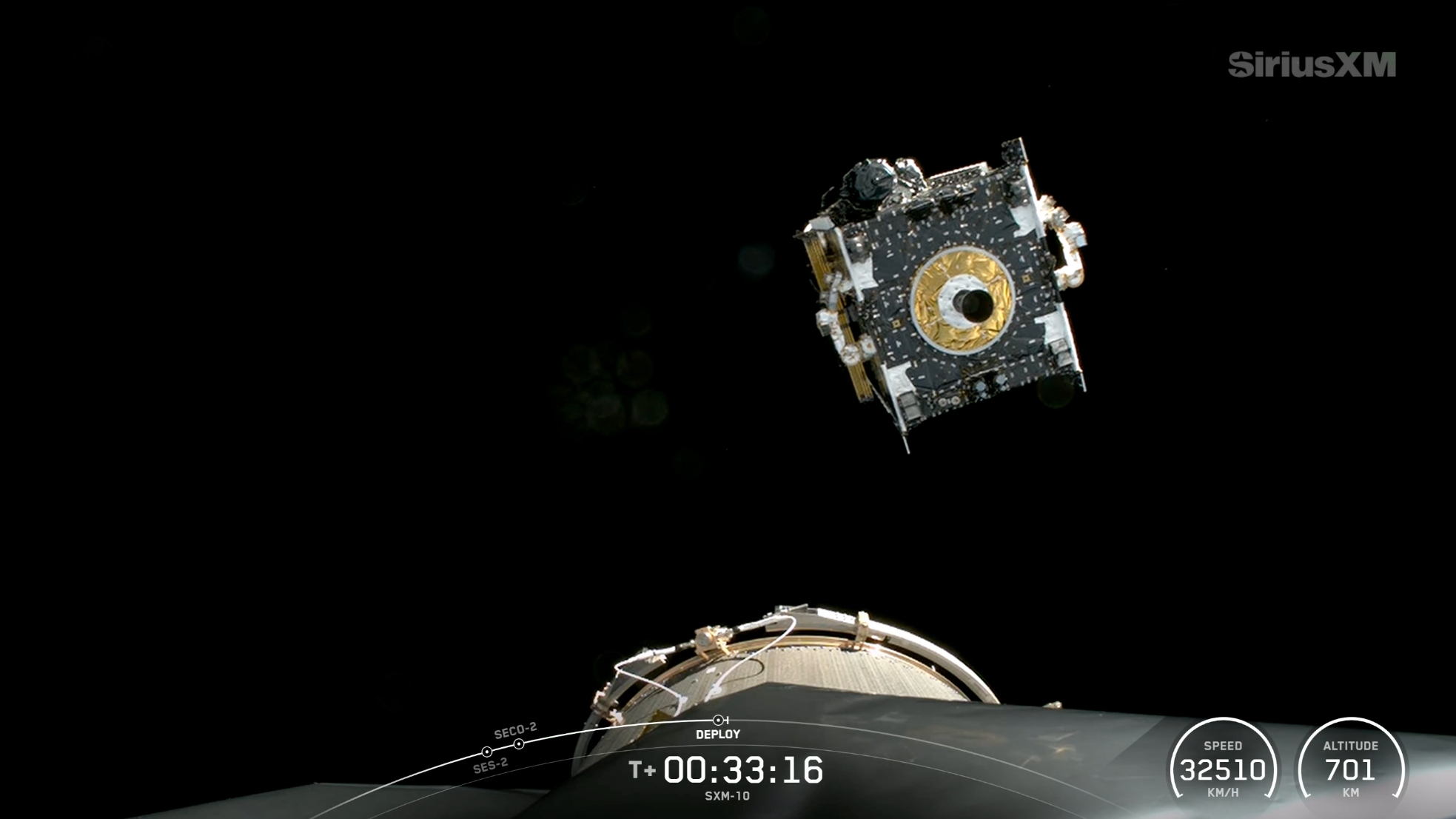
The Falcon 9's upper stage, meanwhile, will continue carrying SXM-11 to an elliptical geosynchronous transfer orbit, where it will be deployed 34.5 minutes after liftoff.
SXM-11 will then circularize its distant path around our planet and join SiriusXM's satellite-radio fleet, which currently consists of seven spacecraft.
Crew 9 | Fram 2 | RRT-1 | Blue Ghost Mission 1 | SXM-10 | MTG-S1 | EchoStar XXV | 9 Starlink missions
SpaceX has launched three of those spacecraft to date — SXM-8 in June 2021, SXM-9 in December 2024 and SXM-10 in June 2025. All rode to orbit on Falcon 9 rockets.
SpaceX has launched 75 Falcon 9 missions so far in 2026. The vast majority of those flights — 80% of them — have been dedicated to building out the company's Starlink broadband megaconstellation in low Earth orbit.