The Hiring Automation “Doom Loop” Is a Warning
Hiring offers an instructive example of how humans can be sidelined by a process accelerated by unchecked automation. Machine-assisted decision-making has long been used in the hiring process to manage volume and improve fairness and efficiency. However, generative AI has made reading and writing job applications almost completely machine-dominated, leading the CEO of Greenhouse, a human resources platform, to declare that AI had created a "doom loop" in hiring. No one intended to create this doom loop, but the adoption of automation in one area led to accelerated adoption in others, ultimately sidelining humans from hiring decisions.
The hiring doom loop is driven by two mutually reinforcing trends: more applicants are applying for each position, and more companies are relying on automation to sift through the growing volume of applications. Applicants per hire tripled between 2021 and 2024, according to one survey of hiring managers, and Greenhouse reported a 412% increase in applicants per post. Applicants are almost certainly using generative AI to spin up customized applications to hundreds of jobs at once.
Meanwhile, 91% of HR departments report using AI in recruitment, and Greenhouse data shows that the number of human recruiters has dropped by over 50%. The recruiters who remain cannot meaningfully evaluate any single application at this volume, further reducing human decision-making in the hiring process. Some companies now use AI to conduct interviews, meaning applicants may not meet an actual human at the company until very late in the process, if at all.
Despite the intention of using AI to improve efficiency and manage scale, only one-third of recruiters reported improvements in time-to-hire using AI, while 25% reported it got slower. More companies are lengthening probationary periods, a sign that they're increasingly unable to identify unsuitable candidates before hiring them. Many job hunters express frustration with encountering bots instead of real humans at their potential future employer. At the same time, scammers and state-sponsored cybercriminals have taken advantage of this automated landscape to advance candidates whose real objective is to steal secrets or cryptocurrency.
A few factors made hiring one of the first processes to fall victim to the doom loop. Hiring managers were early adopters of automation, using technology like keyword-based filters to parse resumes. At the same time, successful cover letters and resumes tend to follow a formula, which makes them easy to convincingly replicate with generative AI. However, there are two factors that are not unique to hiring that make it susceptible to doom loop dynamics:
- Incentives for speed and scale: as competition increases, candidates are rewarded for applying to more jobs, faster.
- Mutually reinforced automation: as application volume outgrew what individuals could manage, automation spread further into the hiring process. This, in turn, drives candidates to prioritize impressing the bots rather than their future human co-workers.
The hiring doom loop is a valuable case study for managing automation because it forces leaders to account for factors outside of their direct control. Instead of responding to machine volume with more automation, developers must think strategically about the intended outcomes and potential second-order effects to ensure systems remain aligned with human intent.
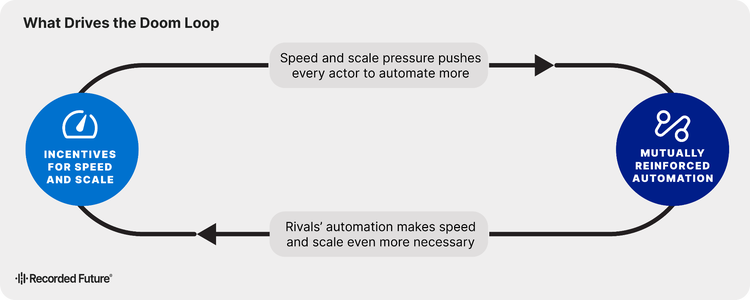
Source: RecordedFuture
Source Link: https://www.recordedfuture.com/blog/the-shift-rethinking-human-in-the-loop