Executive Summary
Insikt Group has identified a series of BlueDelta initial access campaigns conducted between late September 2025 and early April 2026, targeting government and diplomatic organizations in Romania, Spain, and Türkiye. The campaigns delivered a lightweight Windows batch-script backdoor, dubbed "HOOKEDGE," via macro-enabled Microsoft Word documents using diplomatic-themed lures, including material impersonating Spain's Ministry of the Presidency, Justice and Relations with the Cortes, created shortly after a September 2025 meeting between Spanish and Moldovan officials.
Insikt Group assesses with moderate confidence that this activity was conducted by BlueDelta (which overlaps with APT28, Fancy Bear, and Forest Blizzard), a Russian state-sponsored threat group attributed to the Main Directorate of the General Staff of the Armed Forces of the Russian Federation (GRU). This assessment is based on significant code and tradecraft overlap between HOOKEDGE and the HEADLACE backdoor used in prior BlueDelta campaigns, consistent infrastructure patterns, and targeting consistent with known Russian intelligence collection priorities.
HOOKEDGE shares HEADLACE's core architecture, abusing legitimate webhook services for command-and-control (C2), payload staging, and data exfiltration, enabling malicious activity to blend with legitimate network traffic while reducing the operational overhead of dedicated infrastructure. The implant has undergone continuous refinement between September 2025 and April 2026, likely to evade automated sandbox environments and adapt to reduced free-tier API limits on webhook[.]site.
BlueDelta continues to invest in lightweight, easily adaptable initial-access tooling to support intelligence collection against European government and diplomatic targets. Rather than introducing new capabilities, the group has steadily refined its existing tradecraft, emphasizing operational resilience by adapting established tooling to evolving defensive measures and infrastructure constraints.
Organizations should prioritize blocking macro execution from internet-originated documents and implementing detection coverage for scheduled task abuse, headless Microsoft Edge execution, and outbound connections to webhook services.
Key Findings
- Between late September 2025 and early April 2026, BlueDelta conducted a series of initial access campaigns against defense manufacturing and diplomatic organizations in Romania, Spain, and Türkiye. BlueDelta used macro-enabled Word documents to deploy HOOKEDGE, a lightweight batch-script backdoor that shares significant code and tradecraft overlap with BlueDelta’s earlier implant, HEADLACE.
- The campaigns employed both diplomatic-themed and generic lures. Early activity impersonated Spanish government material, while later campaigns adopted generic macro-enablement lures. One diplomatic lure was created shortly after a meeting between Spanish and Moldovan officials, potentially reflecting an effort to collect intelligence relevant to Russia ahead of Moldova’s September 2025 parliamentary elections.
- BlueDelta continued to refine HOOKEDGE between September 2025 and April 2026, introducing changes to lure documents, execution methods, and beaconing intervals while maintaining the malware's core functionality and infrastructure model.
- For targets assessed as having higher intelligence value, BlueDelta deployed a second-stage HOOKEDGE payload with a much shorter beaconing interval. This gave operators more responsive tasking and follow-on activity, while keeping the webhook endpoints used for initial access from being exhausted.
- BlueDelta has historically demonstrated a preference for legitimate internet services (LIS) to facilitate C2, payload staging, and data exfiltration, with webhook[.]site’s free tier serving as the group’s exclusive choice across these campaigns.
Background
BlueDelta is a Russian state-sponsored threat group attributed to the Main Directorate of the General Staff of the Armed Forces of the Russian Federation (GRU), and overlaps with activity publicly tracked as APT28, Fancy Bear, and Forest Blizzard. The group has conducted espionage-focused cyber operations for more than a decade, consistently targeting government, diplomatic, defense, and policy-related organizations in support of Russian intelligence requirements.
BlueDelta has a well-documented history of obtaining initial access through spearphishing, credential theft, and lightweight custom tooling. Previous campaigns have employed malicious documents, Windows batch scripts, and living-off-the-land techniques (LotL), frequently abusing LIS and free web infrastructure for C2, payload staging, and data exfiltration. Insikt Group documented BlueDelta's 2023 use of the HEADLACE malware family, a lightweight, batch-based backdoor used during the early stages of intrusions to execute follow-on payloads and commands in initial access campaigns targeting organizations across Europe.
The activity detailed in this report represents a direct continuation of those operations. The HOOKEDGE backdoor shares significant code and tradecraft overlap with HEADLACE, demonstrating BlueDelta's continued preference for lightweight, easily modified malware that can be rapidly adapted to operational requirements. Similar activity has also been reported publicly by Lab52 under the name Operation MacroMaze.
Threat Analysis
Lure Documents and Targeting
BlueDelta's choice of lure documents across these campaigns reflects deliberate targeting of European diplomatic audiences and reveals collection priorities consistent with known Russian intelligence requirements. Between late September 2025 and early April 2026, Insikt Group identified several malicious macro-enabled Word documents likely used by BlueDelta in initial access campaigns targeting government or diplomatic personnel in multiple European countries.
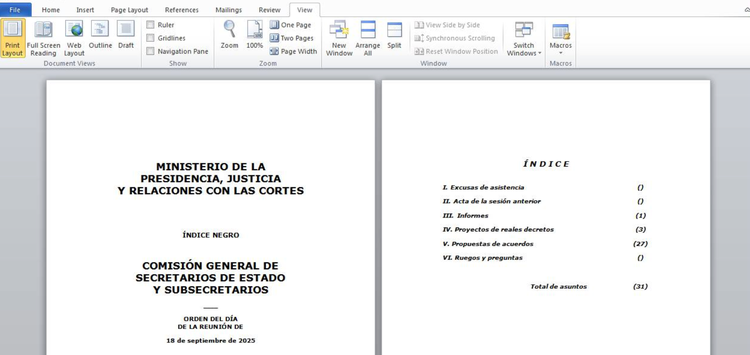
The earliest identified lure, first seen on September 26, 2025, purported to be a September 15, 2025, meeting agenda from Spain’s Ministry of the Presidency, Justice and Relations with the Cortes, as shown in Figures 1 and 2. Although the document’s authenticity could not be verified, BlueDelta has historically used authentic government documents, including publicly available material, as phishing lures.
Source: RecordedFuture
Source Link: https://www.recordedfuture.com/research/bluedelta-targets-with-hookedge