Executive Summary
Venezuelan Acting President Delcy RodrÃguez’s policy decisions will affect economic and political stability in Venezuela in the coming months. Her approach will likely be shaped by a deep familiarity with the state security apparatus, her revolutionary identity, a demonstrated willingness to break from orthodoxy and seek coordination with Washington, an interest in restoring support for the ruling United Socialist Party of Venezuela (PSUV), and a long memory for perceived slights. These principles, paired with changing local power dynamics after the January 3, 2026, United States (US) special operation to capture former Venezuelan President Nicolás Maduro and his wife, Cilia Flores, suggest RodrÃguez is very likely to prioritize near-term governability and economic stabilization over maximalist ideological positioning. At the same time, she will likely find ways to cooperate with the US in ways designed to preserve the rule of PSUV and her credibility with other members of the ruling coalition.
RodrÃguez’s core objectives are very likely to preserve PSUV rule and resist an opposition-led transfer of power, while maximizing the economic benefits of reengagement with Washington, including sanctions relief, investment, and a possible economic recovery. This will likely contribute to RodrÃguez governing in a manner that avoids high-risk moves that could fracture her coalition or trigger instability that undermines her utility to the White House. In this approach, the biggest internal threat she faces in the short term is very likely PSUV rivals, including Interior Minister Diosdado Cabello, Defense Minister Vladimir Padrino Lopez, and other military and economic elites who perceive US engagement as a direct threat to their interests.
While it is impossible to predict every move the Venezuelan government may take, public and private organizations can better anticipate risks to stability and investments — such as resistance to US-supported reforms or evidence of internal divisions in the regime — by systematically monitoring the rhetoric and actions of Delcy RodrÃguez, Diosdado Cabello, and other senior officials using the Recorded Future® Intelligence Operations Platform.
Key Findings
- The January 3, 2026, US operation provoked panic among Venezuelan elites and fueled deep uncertainty regarding the plan to succeed Maduro, which was only resolved when US signaling prompted Venezuelan institutions to confirm that RodrÃguez would assume presidential duties.
- RodrÃguez’s hold on power is threatened internally by rival PSUV figures, chief among them Interior Minister Diosdado Cabello and his network of allies across Venezuela’s security apparatus and among pro-government armed groups.
- Externally, the main threats to RodrÃguez’s power stem from US leverage over Caracas, including US geopolitical aims to bring Venezuela further under Washington’s influence as well as US officials’ stated pursuit of a transition and support for the opposition faction led by MarÃa Corina Machado.
- To avoid a destabilizing rupture that could trigger US backlash, Delcy RodrÃguez will very likely prioritize internal governability and economic stabilization, cooperating with Washington enough to see sustained sanctions relief while seeking to manage rather than expel hardline rivals from her coalition.
- To preserve her own credibility and influence in Venezuela, RodrÃguez is likely to pair compliance with Washington’s demands with “face-savingâ€� gestures that assert Venezuelan sovereignty, and to resist genuinely competitive elections unless economic gains materially improve the PSUV’s electoral odds.
Assessing Current Dynamics in Venezuela
Over the past 25 years, US-Venezuela relations have worsened as Venezuela’s government actively sought to oppose US interests in the Western Hemisphere, deepened relations with US rivals around the globe, and became increasingly authoritarian. This began under the deceased former president Hugo Chávez, whose movement, known as “Chavismo,� has governed the country since 1999. After Nicolás Maduro took power in Venezuela following Chávez’s death in 2013, he accelerated the consolidation of power and the erosion of democratic institutions begun by his predecessor. The US responded by imposing financial and oil sanctions meant to limit Venezuela’s ability to profit from its vast oil reserves and sanctioning over 200 members of the Venezuelan elite. The US pressure campaign on Venezuela accelerated in late 2025 under President Donald Trump, who deployed a historic number of naval assets to the Caribbean.
This military campaign culminated at around 02:00 Venezuelan Standard Time (VET) on January 3, 2026, when US special forces carried out airstrikes and a surgical intervention into Venezuela as part of an operation to capture and extract Maduro and his wife, Cilia Flores, to face drug trafficking and terrorism charges in New York. These events were the most significant US military operation in Latin America since the 1989 invasion of Panama, and ratified a new US doctrine that emphasizes primacy and willingness to use all available tools (economic, diplomatic, and military) to advance US interests in the Western Hemisphere, as laid out in the 2025 National Security Strategy. In Venezuela, the events of January 3 precipitated the most impactful shakeup of the country’s political order in decades.
While Acting President Delcy RodrÃguez has signaled an openness to working with US priorities, this cooperation is affected by active tensions among the ruling elite and longstanding mistrust between Washington and Caracas. Understanding the events of January 3, 2026, and the immediate aftermath is crucial to evaluating the state of play on the ground and in the bilateral relationship.
Uncertainty in the Immediate Aftermath of the US Operation
In the immediate aftermath of the January 3 operation, there was widespread uncertainty in Venezuela regarding the future of PSUV rule. While the constitutional line of succession makes clear that the vice president should assume power in the president’s absence, initial messages from Venezuelan officials emphasized solidarity with Maduro and Flores rather than offering clarity on the future of PSUV governance. There was no official public reaction to the operation from the Venezuelan government until 04:14 VET, when Defense Minister Vladimir Padrino López published a video on social media condemning the attack. He stated that Venezuela’s military — the Bolivarian Armed Forces (FANB) — was declaring a national emergency and deploying at strategic points around the country and called for unity against “imperialist threats.� Statements from Venezuelan officials since then confirmed the raid but did not clarify the makeup of the Venezuelan government.
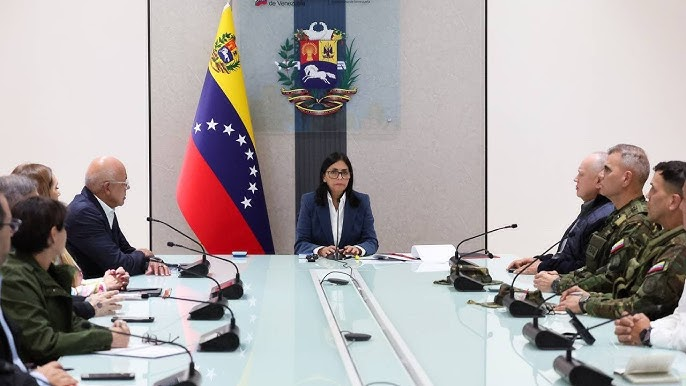
Figure 1: Venezuelan state TV broadcast showing RodrÃguez presiding over a meeting of the
Council of National Defense (Source: Telesur)
The first clarity on Venezuela’s future leadership came from Washington. At roughly 11:50 EST (12:50 VET), US president Donald Trump gave a public address in which he explicitly stated that Washington would work with RodrÃguez as it assumed a more direct role in overseeing the country’s energy and security policies. Trump also said that MarÃa Corina Machado, the most popular opposition figure in the country (who had been outside the country since December 2025 and is currently in Washington) did not “have the support within or the respect within the countryâ€� to rule. While Trump claimed that RodrÃguez had been "sworn in," RodrÃguez’s hold on power was not publicly ratified until 15:20 VET. At that time, state television aired footage of the Council of National Defense, a body made up of the main institutional leaders of the country, featuring RodrÃguez chairing the meeting and Cabello, López, and National Assembly President Jorge RodrÃguez (Delcy RodrÃguez’s brother) present. It was not until roughly 22:00 VET that state media began circulating a decision from the Constitutional Chamber of the Venezuelan Supreme Tribunal of Justice (TSJ) that made clear that RodrÃguez would assume the duties of the president. In its ruling, the TSJ invoked a Chávez-era precedent to overrule constitutional language that would otherwise require her to schedule an early election, effectively indicating that RodrÃguez is very likely seeking a mandate until Maduro’s term ends in January 2031. Neither RodrÃguez nor any other official has yet made this claim explicit, and US officials have suggested that new elections should be held before then. On January 5, she was officially sworn into office in a televised ceremony held in the National Assembly in the presence of key figures in the regime and diplomats from China, Iran, Russia, and Cuba.
US-Venezuela Relations Since January 3
Since January 3, the US has generally signaled support for a working relationship with Delcy RodrÃguez, while making clear that Washington expects full cooperation with its energy and security priorities. In the immediate aftermath of the operation, President Trump told reporters that he might consider a second strike if RodrÃguez did not cooperate, but then, on January 9, announced on Truth Social that he had “cancelled the previously expected second Wave of Attacksâ€� in response to the Venezuelan government releasing a number of political prisoners. Since this announcement, Trump has sought to convey that he and RodrÃguez work closely together. On March 5, 2026, Trump posted on social media that RodrÃguez is “doing a great job, and working with US Representatives very well.â€�
US Secretary of State Marco Rubio has also expressed a willingness to work with RodrÃguez’s interim government, but provided more explicit emphasis on a transition as the ultimate end goal of US policy. Speaking to reporters on January 7, Rubio described the US approach as consisting of three main phases: stabilization, recovery, and transition. Stabilization, he stated, is needed to prevent Venezuela from “descending into chaos,â€� which would be avoided by US control over oil-sale proceeds. Rubio clarified that the “recoveryâ€� phase would be aimed at reopening the oil sector to US and other Western firms, and it would ultimately be followed by a “process of transitionâ€� that would include reconciliation among Venezuelans. This three-phase framing has been echoed by other US officials, although to date, no fixed timeframe for a transition has been made public. US officials have also said that severing Venezuela’s ties to Russia, China, Cuba, and other US geopolitical adversaries is a top priority in the relationship.
US-Venezuela coordination on energy policy appears to be advancing rapidly. On January 29, Venezuela’s PSUV-controlled National Assembly passed a reform to the country’s Organic Hydrocarbons Law, aimed at increasing autonomy for private companies involved in the country’s oil and gas industry. While the revised law continues to assert state ownership over hydrocarbon reserves, it broadens the mechanisms through which private companies can participate in upstream activity, including allowing private operators — via contracts with state-owned energy company Petróleos de Venezuela S.A. (PDVSA) or joint ventures — to assume operational control while retaining a share of production. The reform also introduces a much more flexible framework for royalties and taxes, which can be set on a case-by-case basis by the Ministry of Energy, with royalties of up to 30% and taxes of up to 15%. Previous windfall taxes have been eliminated in this reform.
US support for revitalized energy cooperation with Venezuela has been enthusiastic, and President Trump has actively encouraged US and other Western oil companies to invest as much as $100 billion in Venezuela. Two days after the passage of the Organic Hydrocarbons Law reforms, the US sent Chargé d’Affaires Laura Dogu, who leads the Venezuela Affairs Unit out of the US Embassy in Colombia, to Caracas, where she is tasked with overseeing the restoration of diplomatic ties with Venezuela. While Dogu has conveyed US support for closer relations, she has reiterated US support for an eventual transition. On February 2, she met with RodrÃguez, and afterward posted on X that in the meeting she reiterated “the three phases that Secretary Rubio has outlined for Venezuela: stabilization, economic recovery and reconciliation, and transition.â€�
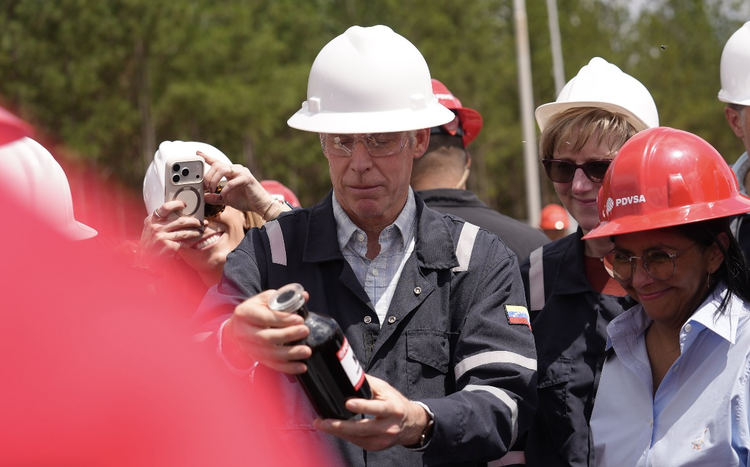
In the wake of the Organic Hydrocarbons Law reform, the US Treasury Department’s Office of Foreign Assets Control (OFAC) issued a series of general licenses allowing US and other Western companies to produce, refine, transport, and sell oil without seeking individual exemptions, effectively lifting sanctions that had previously restricted these activities (see Appendix A). These OFAC licenses mandate that any authorized transactions with Venezuela's government or state energy company PDVSA must follow US laws (with disputes being resolved in the US), and that payments to the Venezuelan government or any other Venezuelan sanctioned entity be made into a US-overseen fund. US support for energy investment in Venezuela was emphasized from February 11 to 12, when US Energy Secretary Chris Wright led a delegation to Caracas to meet with RodrÃguez, becoming the highest-ranking US official to visit Venezuela in years.
Internal and External Threats Confronting Acting President RodrÃguez
Since Acting President RodrÃguez took over from Maduro in the immediate aftermath of the US operation on January 3, she has voiced support for cooperation with Washington — but her incentives to cooperate fully are very likely limited. RodrÃguez is aware of Washington’s “three point planâ€� for Venezuela and is likely supportive of US plans to stabilize the country, lift sanctions, and promote investment. However, she is almost certainly seeking to preserve her rule and a government led by the PSUV, and will very likely resist any attempt to preside over a transition of power to an opposition-led government. Her ability to do so will very likely depend on her ability to consolidate power and manage potential spoilers within her own coalition, as well as her ability to deepen cooperation with US interests and demonstrate utility to the White House. In doing so, she faces a number of internal and external threats to her rule, which include challenges by rivals inside the ruling PSUV over the next six to twelve months, and pressure by Washington to hold new elections over the next twelve to twenty-four months.
Internal Threats to RodrÃguez’s Rule
The main internal threat to RodrÃguez’s power in the short term is other members of the ruling elite. She has steadily worked to consolidate power and secure the support of the military and intelligence services, but her support among the country’s political and economic sectors is far from settled. There are almost certainly key figures in the security forces, the business community, and in the ruling party who view RodrÃguez, and her relationship with the US, as a challenge to the previous status quo and its associated privileges, economic arrangements, and patronage schemes. They may be concerned about their future influence, immunity for illicit activities or involvement in repression, and control over licit and illicit revenue streams.
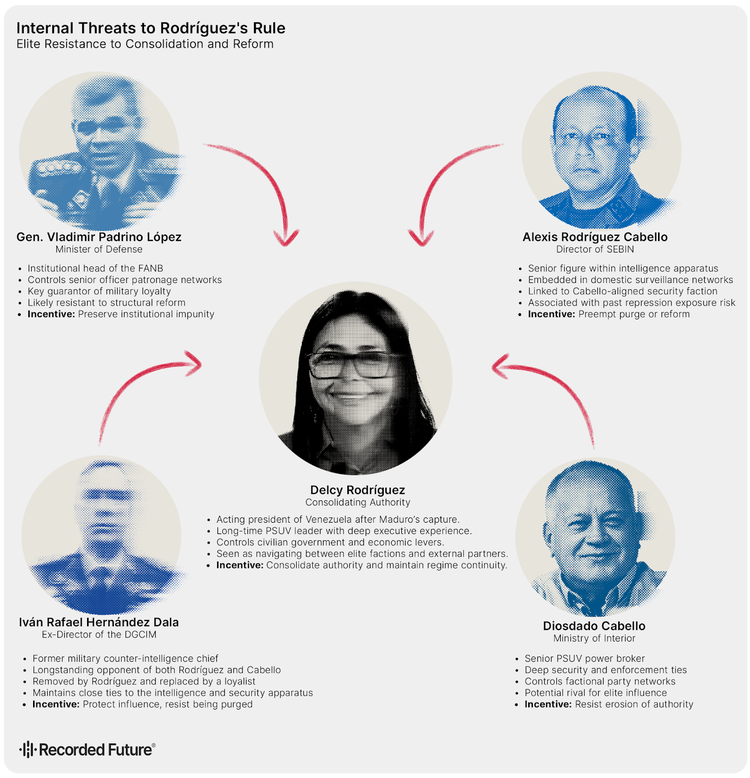
As RodrÃguez continues to establish her rule, some of these individuals may seek to oppose her, either by seeking to derail or sabotage her rapprochement with Washington or by openly rebelling against her. In this context, an attempted palace coup cannot be ruled out. Her primary rivals include the following figures and networks, each of whom has a distinct power base and incentive to view RodrÃguez as an adversary or rival:
- Diosdado Cabello, Minister of Interior, Justice and Peace. Cabello is a senior power broker within the ruling party and has been the PSUV’s Secretary General since 2011. He has deep connections to the security services and hardline enforcement networks, including to pro-government armed paramilitary organizations known as “colectivosâ€� (see Figure 3). State media has sought to downplay reported tensions between Cabello and RodrÃguez, but Cabello’s incentives to undermine her are straightforward: Her consolidation of power threatens his influence over the party, the security apparatus, and his networks. He is also the only current cabinet member who was named in the unsealed drug trafficking indictment US prosecutors issued to capture Maduro, and he likely suspects that RodrÃguez may eventually hand him over to the US.
- General Vladimir Padrino López, Minister of Defense. Padrino’s likely core incentive is to preserve his influence as the institutional head of the FANB, and to preserve the patronage networks underneath him. He also likely seeks to protect senior officers from eventual prosecution for corrupt activities or involvement in repression, and therefore very likely views RodrÃguez’s government as a challenge to longstanding FANB impunity. While there is no public evidence of any cracks between Padrino López and RodrÃguez, it is very likely that he will resist meaningful reforms inside the armed forces
- Major General Alexis RodrÃguez Cabello, Director of the Servicio Bolivariano de Inteligencia Nacional (SEBIN). Cabello is a cousin of Diosdado Cabello and is believed to be close to him. As head of the primary intelligence service, RodrÃguez Cabello has strong incentives to resist reforms that would expose him or his network to prosecution, and to preempt any purge that might impact him or his network.
- Major General Iván Rafael Hernández Dala, former director of the General Directorate of Military Counterintelligence (DGCIM). Hernández Dala, a close confidant of Maduro, was head of DGCIM until replaced by RodrÃguez in January 2026. He is also believed to be a longstanding opponent of both RodrÃguez and Cabello, and of their respective factions in the PSUV. Even if sidelined from formal command, Hernández Dala likely retains networks inside the intelligence and security apparatus. He likely has incentives to undermine RodrÃguez if he anticipates facing prosecution for past abuses, loss of status, or exclusion from any protection or economic deals between Washington and Caracas.
- Business and Political Elites Tied to Maduro. Maduro and Flores dominated Venezuelan politics for nearly thirteen years. During that time, they cultivated a vast network of well-connected economic, military, and political elites that helped them sustain power. Many of them are not overtly tied to the RodrÃguez siblings, and instead may be willing to ally themselves with rival factions to advance their own interests. Possible figures in this category include:
- Tarek William Saab, Acting Ombudsman. Until his resignation in February 2026, Saab served as attorney general since 2017 and held significant influence over how the repressive apparatus was deployed, overseeing detentions and prisoner releases. Saab’s resignation was very likely forced, and he has clear incentives to resist any reform process that reduces his discretion or creates a credible path to independent investigations into past repression or corruption.
- Nicolas Maduro Guerra, also known as “Nicolasito.â€� A member of the National Assembly and son of Maduro and Flores, Maduro Guerra is not one of the top PSUV powerbrokers in his own right but has played a crucial role in securing continuity by appearing publicly with RodrÃguez and claiming she has his parents’ full support. Given lingering questions over internal Chavista involvement in the January 3 operation, he has leverage to complicate RodrÃguez’s narrative and may seek to use it if he feels that his interests are threatened by the RodrÃguez administration.
- Alex Saab. Saab played a crucial role in facilitating sanctions evasion networks until his arrest by US law enforcement in 2020. Saab was later returned to Venezuela in a 2023 prisoner swap, and Maduro rewarded him by making him Minister of Industry and National Production. RodrÃguez replaced him in January 2026, likely understanding that Saab was not palatable for US business interests, but Saab likely retains enough social capital within Venezuela’s private sector to pose a challenge to RodrÃguez. This is the likely reason why Saab was reportedly detained by Venezuelan intelligence in February 2026, although his lawyer has maintained that he is not under arrest.
External Threats to RodrÃguez’s Rule
US Pressure to Box Out Geopolitical Adversaries
In the short term, the most significant external threat that RodrÃguez faces is a reversal of United States policy — either via renewed military or intelligence operations intended to force her removal, or through a more indirect pressure campaign meant to trigger a domestic fracture. A second US special forces operation to depose her outright is unlikely, but it remains a scenario RodrÃguez and her circle will have to treat seriously, given the direct and disproportionate leverage that Washington currently holds over Caracas. More likely than further military action is the prospect of renewed pressure: the US can calibrate sanctions relief, revoke OFAC licences, and facilitate or block diplomatic recognition in ways that shape incentives and perceptions of the regime’s survivability among Venezuelan elites. Recent reporting suggests Washington is simultaneously pursuing deepened energy engagement while remaining skeptical about whether RodrÃguez will fully align with US strategic demands, which increases the possibility of an abrupt shift away from RodrÃguez if she does not deliver on US priorities.
A major fault line in the US-Venezuela relationship is Venezuela’s ongoing relationships with US geopolitical adversaries, namely China, Russia, Iran, and Cuba, even as the US has increasingly sought to box them out of Venezuela. US officials publicly demanded that Venezuela cut ties with adversary nations and have actively moved to push them out. The US has successfully pressured Venezuela to end fuel shipments to Cuba, and OFAC general licenses intended to facilitate Venezuelan oil and gas activity explicitly do not authorize transactions involving Russian, Chinese, or Iranian entities. In spite of this, RodrÃguez has sought to publicly demonstrate an interest in retaining these partnerships.
Opposition Efforts to Limit US-Venezuela Engagement
Another short-term external threat to RodrÃguez is opposition figure MarÃa Corina Machado. While she remains the most popular opposition figure in Venezuela, and her faction has a demonstrated capacity to organize protests on the ground, these have so far not presented a significant threat to stability or to PSUV governance. Her presence in Washington since December 2025, however, has provided her with a major platform to directly shape the US foreign policy debate over Venezuela. With Machado and close advisors operating from Washington, she has advanced a narrative publicly supportive of the US agenda while privately calling on allies in Congress and in the international community to press for a clearer timetable for new elections and the ouster of the PSUV. She has also used her platform to promise she will return soon, and to highlight perceived inconsistencies between RodrÃguez’s actions and her rhetoric, noting, for instance, the gap between the government’s claimed political prisoner release numbers and the figures cited by independent rights organizations.
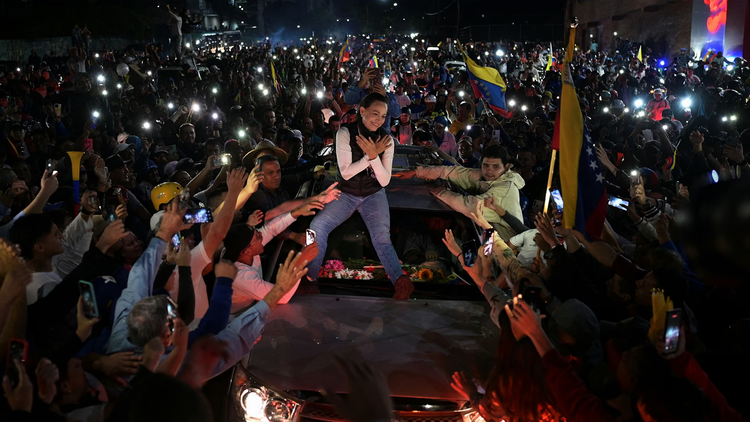
Machado has received strong support from bipartisan lawmakers in the US House and Senate, who have questioned US engagement with RodrÃguez. While Machado’s efforts to raise the political cost of engagement with the RodrÃguez government have earned her support from some allies in Washington, the White House has reportedly expressed frustration with her criticism, with officials claiming it undermines US policy. These efforts very likely represent a lesser threat to RodrÃguez’s hold on power, given White House insistence on working with RodrÃguez, but introduce persistent uncertainty into the sustainability of US support for her.
Calls for a Competitive Election
Beyond these immediate pressures, the most important mid-term threat to RodrÃguez and to future PSUV rule is the election timeline reportedly being promoted by the Trump administration. While the US has refrained from presenting a specific timetable, officials ranging from Chargé d’Affaires Dogu to Secretaries Rubio and Wright have increasingly signaled publicly that the US expects to see new elections in the next eighteen to twenty-four months. The specifics of these elections, like whether they would be only presidential or include broader general elections (to replace the PSUV-dominated National Assembly), have not been disclosed, but the US insistence on elections in some form very likely forces RodrÃguez to reconcile her approach to coalition management with a desire to seek electoral legitimacy on a compressed timeline.
At the moment, RodrÃguez, her inner circle, and PSUV elites almost certainly view a competitive presidential election as an existential threat. Polls have repeatedly demonstrated that the PSUV is unpopular. While RodrÃguez is the most popular figure in the PSUV, she would very likely lose a presidential race with Machado by a two-to-one margin, and Machado would very likely defeat any PSUV candidate absent a significant shift in public opinion. Maduro’s removal has not automatically revived grassroots loyalty to the ruling party, with local PSUV leaders describing fractures, demobilization, and severe drops in participation inside local party structures since January 2026.
Given the PSUV’s lack of legitimacy, US support for elections will likely become a flash point in the relationship with Rodriguez. These tensions will also very likely be exacerbated by opposition mobilization inside the country and Machado’s efforts to marshal support in Washington. While US authorities have not yet demanded that Machado be allowed to return to Venezuela (and has reportedly asked her to delay any plans to this effect), her return is almost certain to occur well in advance of an election as she has openly said she will run. The temporary re-arrest of opposition figure Juan Pablo Guanipa in February after he began organizing anti-government rallies suggests the ruling party will likely seek to use the repressive apparatus to restrict Machado’s campaigning efforts, elevating the likelihood of pre-election instability. Even if a competitive election is held under the PSUV, the experience of the July 2024 election suggests that the ruling party is unlikely to recognize the results if the opposition wins, raising the likelihood of post-election instability, protests, and violence.
Delcy RodrÃguez’s Origins and Principles of Her Approach to Decisionmaking
Before her emergence in recent years as the face of relative economic pragmatism in Chavismo, Delcy RodrÃguez’s background was not well-known internationally. But her rise to power reveals a number of factors that likely inform her approach to governance and likely impact the prospect for political and economic stability moving forward. These include:
- Familiarity with Venezuela’s Intelligence and Repressive Apparatus: In addition to her reputation as an economic reformer, RodrÃguez likely has a deep familiarity with intelligence work that, according to state media, goes back to the Chávez years. In 2002-2003, she reportedly worked with the SEBIN’s predecessor agency, the Dirección General Sectorial de los Servicios de Inteligencia y Prevención (DISIP), on undisclosed counterintelligence work involving “geopolitical reportsâ€� with former DISIP head Eliezer Otaiza. From the time she rose to the office of Executive Vice President in 2018 until 2021, the SEBIN technically fell under her office. While there is no publicly available evidence that she explicitly directed SEBIN-led repression of dissidents, her role likely afforded her a deep familiarity with the main Venezuelan intelligence agency’s response during the government’s crackdown on the post-2018 election protests and the 2019 protest wave led by opposition figure Juan Guaidó. It is likely that she was, at a minimum, aware of acts of torture, extrajudicialleged human rights violations and crimes against humanity since 2014 that have been credibly documented by the Independent International Fact-Finding Mission on Venezuela created by the United Nations (UN) Human Rights Council.
- Identity Shaped by Revolutionary Politics: RodrÃguez was born in Caracas in 1969 and grew up in a politically active left-wing family. Her father, Jorge Antonio RodrÃguez, founded an armed urban guerrilla group and was killed in police custody in 1976, allegedly under interrogation. His death made him a martyr among the Venezuelan left, which cemented the revolutionary identities of RodrÃguez and her older brother Jorge from an early age. RodrÃguez has framed her decision to study law as an effort to “do justice for her father’s case,â€� and both she and her brother routinely cite his death as a justification for their support for Hugo Chávez and the movement he founded. In public, RodrÃguez has repeatedly expressed strong support for the ruling party’s socialist ideology. In a September 2019 address to the United Nations General Assembly, she criticized “capitalist supremacismâ€� and ended with a call to “save the world from capitalist violence.â€�
- Willingness to Break from Ideological Purity: In practice, RodrÃguez’s rise demonstrates that she is open to abandoning ideological purity in order to accomplish her objectives. Unlike Maduro and other ruling party figures who developed close personal ties to Chávez, she had a notoriously poor relationship with the former leader and spent significant time outside Venezuela in her formative years. RodrÃguez studied law at the Central University of Venezuela, but later pursued postgraduate studies abroad in labor law in London and Paris, and reportedly spent time in the United States. She speaks English and French. RodrÃguez returned to Venezuela after an opposition-led failed coup attempt against Chávez in 2002, and first worked as an advisor in the Foreign Ministry, and then as Deputy Minister for European Affairs before ending up as Chávez’s Minister for Presidential Affairs. She did not last long in this position, however, and was abruptly dismissed after she reportedly argued with and insulted him during a presidential visit to Moscow. RodrÃguez then adopted a lower profile in Venezuelan political life until Maduro took power, who made her his foreign minister in 2014. As foreign minister (2014-2017), president of the pro-government National Constituent Assembly (2017-2018), and then as executive vice president (2018-2026), she developed a reputation as a shrewd political operator and staunch Maduro ally.
- Interest in Addressing PSUV’s Declining Popularity: Although RodrÃguez was and arguably remains a Maduro ally, she has demonstrated a clear awareness of how the PSUV’s economic mismanagement has led to its declining popularity and has shown an interest in reversing it. Ahead of the 2018 presidential election, she briefly led a satellite party of the PSUV called the Movimiento Somos Venezuela (“We Are Venezuela Movementâ€�) and served as its leader in a likely attempt to “rebrandâ€� Chavismo and connect with a younger generation of Venezuelans. She was officially reincorporated into the PSUV’s leadership in late 2018 after her party failed to account for more than six percent of Maduro’s reelection vote. When Maduro made RodrÃguez his Minister of Economy in 2020, she began to advance an agenda of relative economic liberalization, and brought on a team of Ecuadorean advisors to impose tighter fiscal discipline and stabilize the exchange rate, eventually promoting the de facto dollarization of the economy. The success of the policies contributed to a modest but important economic rebound and led Maduro to appoint her in 2024 as Energy Minister as well, a post she technically still occupies. In overseeing this economic agenda, she began to cultivate a reputation for herself as less of an ideologue and more of a pragmatist, and began to pursue closer relationships with major energy companies and other investors. This reputation almost certainly contributed to the US decision to engage with her government after removing Maduro.
- Calculating Operator with Sense of Persecution: RodrÃguez has a history of keeping track of past instances where she has been slighted, even referring to her support of Chavismo and of its revolution as her and her brother’s “personal revengeâ€� for the death of their father. RodrÃguez herself has alluded to this trait on state media. In a 2024 appearance on the Con Maduro Podcast, she recalled running into former Argentine President Mauricio Macri, a vocal critic of the Venezuelan government, at the 2022 World Cup in Qatar. Macri had recently been made the Executive Chairman of the FIFA Foundation, and, according to RodrÃguez, she shook his hand and told him: "Did you see where you are now, and where we are? We're with the Venezuelan people. And you? You're here picking up balls.â€� RodrÃguez is also a savvy operator, and her rise to prominence reflects not only her ability to deliver on economic policy objectives but also her ability to outmaneuver rivals. The best-known instance of this is her leadership of an anti-corruption campaign in 2024, which resulted in the imprisonment of former vice president, oil minister, and longtime rival Tareck El Aissami.
- Openness to Dialogue with Washington: Even before the current rapprochement between Washington and Caracas, RodrÃguez was known for consistently favoring a deeper diplomatic relationship with Washington — albeit one built on mutual respect. During the 2022 phase of exploratory talks in which the two countries negotiated sanctions relief in exchange for holding presidential elections in 2024, RodrÃguez publicly maintained that the relationship “cannot be conditioned,â€� saying that Venezuela’s doors were open to any country that arrived “with respectâ€� and treated it as an equal under international law. During this period, she specifically centered the importance of discussing US oil and gas interests in bilateral diplomacy, saying that Venezuela was willing to pursue “energy dialogueâ€� with US firms, indicating a view of energy cooperation as a channel for de-escalating tensions.
A Framework for Anticipating Delcy RodrÃguez’s Policy Decisions
When Delcy RodrÃguez faces policy decisions that impact economic and political stability in Venezuela in the coming months, her approach is likely informed by the pillars described above: her revolutionary identity, tactical pragmatism, openness to US engagement, an interest in restoring popular support for the PSUV, a long memory for slights, and familiarity with the security apparatus, as well as the internal and external short- and mid-term threats to her rule. Given these factors, Insikt Group assesses that she is very likely to prioritize near-term governability and economic stabilization over maximalist ideological positioning, while likely cooperating with the US in ways that preserve her credibility inside the ruling coalition. This matters for prospective investors because it suggests the Venezuelan government is likely to seek to maintain a pragmatic economic policy environment focused on short-term macroeconomic stability. At the same time, companies seeking to invest will almost certainly continue to face elevated sanctions compliance risks and potential policy reversals depending on the evolving Washington-Caracas relationship, making it critical to closely monitor RodrÃguez’s evolving policy decisions and internal relationships.
Coalition Management over Open Confrontation with Rivals
RodrÃguez will likely prioritize maintaining and reconfiguring her coalition over seeking conflict with internal rivals, because the external pressure she faces makes internal rupture more risky than compromise. Her main rival, Diosdado Cabello, has significant sway over the repressive apparatus and over pro-government armed “colectivosâ€� loyal to him, and his removal could therefore provoke unrest and destabilizing violence. This is precisely the kind of chaos Washington has sought to avoid, and very likely why it opted to keep RodrÃguez in place as interim president in the first place. She therefore likely assesses that purging, detaining, or otherwise sidelining Cabello or other top PSUV rivals could risk calling into question her ability to maintain order, and would undermine her position with Washington as a lynchpin of relative calm and continuity.
This is likely the reason that RodrÃguez has sought to balance the ruling coalition since taking power rather than immediately shaping it to align with her preferences. Although she elevated her allies to higher positions in her government early in her tenure — such as appointing Calixto Ortega as Vice President of Economy — she has largely kept the ruling apparatus in place. Not only has she left a number of other figures close to Cabello in their positions, but she has also promoted figures in Cabello’s network. She named Gustavo González López, believed to be a Cabello ally, to lead both the Presidential Honor Guard and the Directorate General of Military Counterintelligence (DGCIM). She also appointed Cabello’s daughter, Daniella Cabello, to be Minister of Tourism — a significant post that will afford her a direct role in reopening Venezuela to international commercial activity. These moves were likely taken out of a desire to effectively secure Cabello’s support for her economic normalization agenda.
Face-Saving Cooperation with Washington
RodrÃguez will likely continue to cooperate with Washington’s energy priorities, but she will very likely pair this compliance with visible signaling aimed at saving face with PSUV loyalists. This is likely why, even as she has received high-level US officials in Caracas and even spoken with Trump over the phone, she has publicly demonstrated support for retaining partnerships with US adversaries. On January 8, for instance, Cuban Foreign Minister Bruno RodrÃguez traveled to Caracas and accompanied the interim president to speak at a commemoration event at Venezuela’s Military Academy for the Cuban and Venezuelan casualties from the January 3 US operation to capture Maduro. This was RodrÃguez’s first event in which she officially presided over a military ceremony as commander in chief of the armed forces. On the same day, state-run media reported that RodrÃguez held a meeting with Chinese Ambassador to Venezuela Lan Hu, in which she thanked China for its support for Venezuelan sovereignty and described the encounter as “cordial.â€� The ambassadors of China, Russia, and Iran were given front row seats to RodrÃguez’s January 5 swearing-in ceremony, and state TV broadcast images of the Venezuelan leader greeting them affectionately.
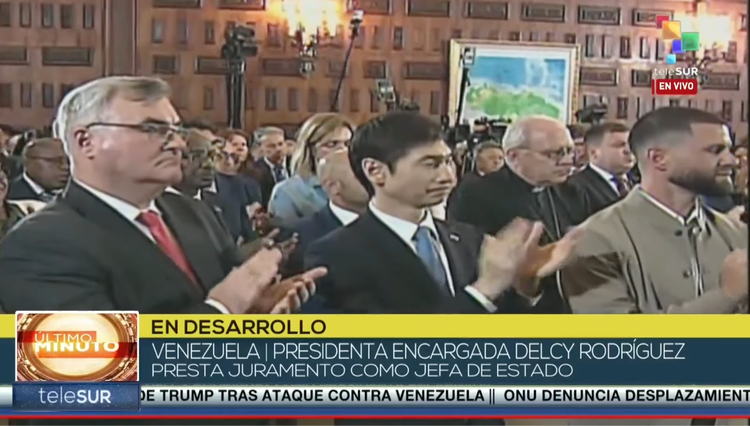
Such gestures will very likely continue as they offer RodrÃguez a way to preserve credibility among PSUV elites and everyday party faithful. She can claim that her rapidly evolving relationship with Washington is a sovereign decision that improves stability and living conditions, rather than a relationship that is shaped by a drastically uneven playing field. As part of presenting an image of mixed compliance with Washington’s demands for Venezuelan audiences, she will almost certainly continue insisting that Maduro remains the legitimate president and demand his return, even as she works to consolidate her own power.
Leveraging Hardliners to Justify Non-Compliance
The internal rivalries identified above represent significant threats to RodrÃguez’s legitimacy inside the PSUV and her claim to power, and attempting to balance her coalition while consolidating her control will almost certainly be a major challenge for RodrÃguez. However, it is likely that RodrÃguez will, over time, point to alleged hardliners to justify selective non-compliance with US aims, credibly or otherwise. Ultimately, it may be useful for RodrÃguez to be able to point to ongoing tensions in her coalition or the prospect of instability as a way of warding off US pressure for an eventual transition or for competitive elections to be held. This justification is likely to lose credibility over time if she continues to consolidate administrative control and accumulate legitimacy, especially if she presides over significant economic gains amid US sanctions relief. Ultimately, the very steps that allow her to consolidate her rule may eventually be used by Washington to justify accelerating the end of it.
Resistance to Elections if Seen as an Existential Threat
RodrÃguez’s past political experience and the PSUV’s record across more than 25 years of governing suggest the Venezuelan government will very likely seek to maximize political gain from any economic growth resulting from US sanctions relief and economic normalization. And while US officials have routinely conveyed that they expect elections to be held in the next two years, the Venezuelan government is almost certain to resist or sabotage elections unless it perceives that economic improvement has boosted the PSUV’s chances of winning a competitive election. Even then, the PSUV will very likely seek to use its control of government to activate patronage networks, divert public resources to politicized social programs, and attempt to present legal obstacles to opposition campaigning — just as it did in the lead-up to the 2024 presidential election.
Ultimately, this logic is consistent with how Chavista elites have historically conceptualized elections: In multiple instances of US-backed talks meant to offer sanctions relief in exchange for competitive elections, Venezuelan government negotiators routinely argued that elections can be considered “fairâ€� only if voters can judge the government without the distorting economic effects of sanctions. If economic growth does not translate into a boost in popular support for the ruling party, RodrÃguez will likely come under increasing pressure from rivals to resist a US-backed transition. It is therefore likely that democratization in Venezuela will be phased and gradual, not immediate, and will likely depend in large part on whether elements of the ruling elite see a viable future for themselves in the country as a possible outcome after alternating power.
Outlook
Over the coming months, Delcy RodrÃguez is very likely to prioritize near-term governability and economic stabilization over maximalist ideological positioning, while still finding ways to cooperate with the United States that preserve her rule and credibility inside the ruling PSUV coalition. In the short- to mid-term, the main challenge she faces is the threat posed by internal rivals who may feel threatened by her reforms. This makes her cabinet changes, and evidence of backlash among political and economic elites, crucial variables to watch. In confronting internal threats to her rule, she will likely pursue a strategy of coalition management over one of open confrontation. Even as RodrÃguez continues to consolidate power and tries to keep hardline rivals contained, she will likely avoid high-risk moves that could fracture elite support and risk threatening her relationship with Washington.
In the short and mid terms, the main flashpoints will be US pressure to end Caracas’s relationships with Moscow, Beijing, and other US adversaries, as well as US pressure to hold competitive elections in the next two years and eventually to advance a political transition. RodrÃguez and PSUV elites likely view a genuinely competitive presidential vote as an existential threat. As a result, the government is almost certain to resist or sabotage competitive elections unless economic improvement significantly boosts the PSUV’s electoral odds. Even then, it would likely use patronage, politicized social programs, and legal obstacles to constrain opposition campaigning and preserve an institutional advantage. This raises the prospect of instability both in the lead-up and in the aftermath of any elections, given the likelihood of opposition protests and an associated crackdown. Given these dynamics, any transition is more likely to be phased and gradual than immediate, with stability hinging on whether RodrÃguez is able to consolidate support among the ruling elite and whether the broader Chavista coalition can see a viable future for itself under any eventual alternation of power.
Appendix A: 2026 OFAC Licenses Issued for Venezuela
Venezuela General License 48: “Authorizing the Supply of Certain Items and Services to Venezuela
�
Table 1: A list of OFAC general licenses issued since the passage of the Venezuela hydrocarbons law(source: US Office of Foreign Assets Control)
Source: RecordedFuture
Source Link: https://www.recordedfuture.com/research/understanding-and-anticipating-venezuelan-government-actions