Executive Summary
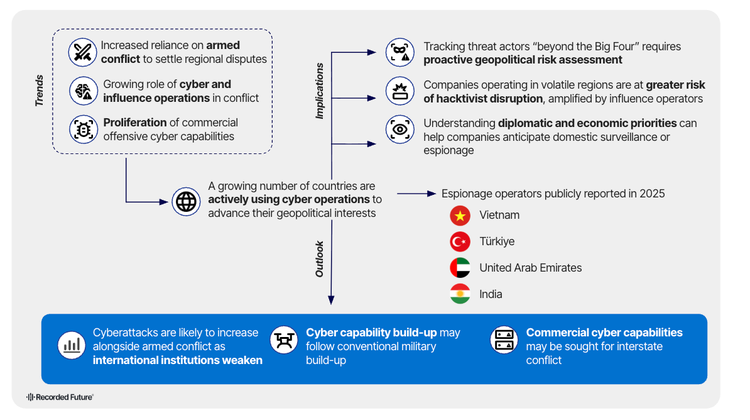
Regional conflicts and weakened international institutions are driving the use of offensive cyber operations beyond the “Big Four” (China, Russia, Iran, and North Korea). Monitoring these threat actors requires organizations to proactively assess their geopolitical risk to understand where future threats are most likely to emerge.
In 2025, Recorded Future identified at least twenty actors across thirteen “non-Big Four” countries conducting cyber operations, primarily linked to regional conflicts, domestic surveillance, or foreign espionage.
Companies should closely monitor regional geopolitics and maintain strong continuity and resilience plans to protect against cyber espionage or disruptive cyberattacks.
Analysis
Overview of Other State Sponsors of Cyber Operations
While the “Big Four” account for the majority of reported cyber threat activity, many other countries use cyber operations to advance their strategic interests. Recorded Future data shows that most observed activity outside of the “Big Four” stems from regional conflicts. Patriotic hacktivist groups, which advance state interests alongside state-sponsored espionage operations, represent the highest volume of reported activity. The degree of coordination between hacktivists and the government remains unclear and likely varies. However, their actions are included in this assessment because of their close alignment with state objectives, which means their activity correlates with interstate conflict risk.
Outside of active conflict, espionage against foreign and domestic targets continues to be a major driver of cyber operations. The most cyber-capable states invest heavily in avoiding detection and attribution, given the significant negative political consequences of exposure.
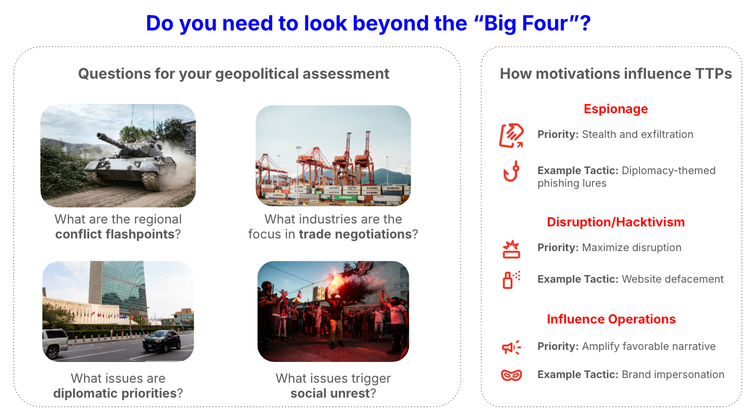
Tracking threat actors beyond the Big Four requires organizations to understand their geopolitical risk in order to anticipate where threats are most likely to emerge. Operating in certain regions or conflict zones likely increases the risk of cyber espionage or destructive attacks.
Regional Cyber Conflicts
Territorial disputes drove nearly two-thirds of observed cyber activity in 2025, according to Recorded Future data. Cyber operations focused on intelligence collection against government, defense, and other critical infrastructure. Hacktivists escalated their activity during conflicts, carrying out nuisance-level attacks amplified through influence operations. Like hacktivists, influence operations align closely with state interests during conflict, but have varying degrees of connection to the state. These activities rarely affect battlefield outcomes but are designed to signal technical sophistication or moral superiority over the adversary.
India and Pakistan
Between May 7 and 10, 2025, India and Pakistan exchanged a series of missile strikes — the most serious escalation between the two nuclear-armed countries in decades. Throughout the crisis, large volunteer hacktivist communities on both sides conducted disruptive attacks, primarily DDoS and website defacements. Pakistan-linked APT36 conducted espionage operations targeting the Indian government and other politically motivated targets, while threat actors linked to the Indian government, such as SideWinder, pursued Pakistani military targets.
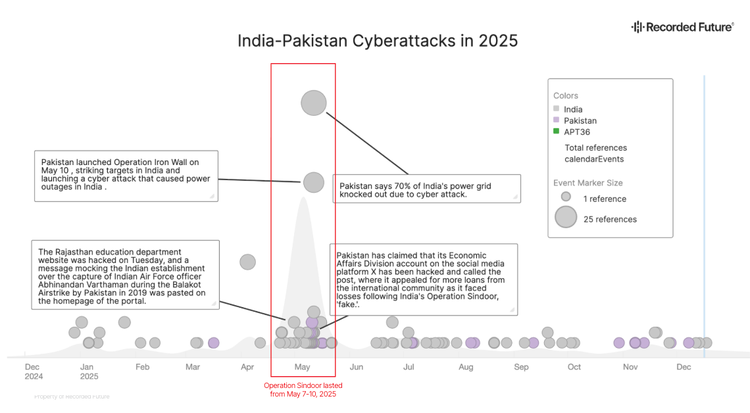
Influence operations intended to shape perceptions of the conflict also intensified. Influence networks amplified hacktivist claims, often overstating their impact, such as widespread reporting on Pakistani social media that hackers had shut down 70% of India’s electric grid. These operations are intended to portray their own side as more capable and their adversary as vulnerable, underscoring the importance of narrative control in conjunction with military operations.
Thailand and Cambodia
Similar to cyber engagements observed between India and Pakistan, hacktivist operations bolstered by influence campaigns significantly escalated between Thai hackers and Cambodian hackers following the May 2025 conflict. These were largely carried out by self-proclaimed patriotic hacktivist groups. Operations included DDoS attacks, website defacements, and data leak operations. More targeted hack-and-leak operations were also intended to reveal politically damaging information about the other country’s leadership. Influence operation narratives emphasized that the opposing side was the aggressor in the conflict, likely in order to garner both domestic and international support.
Morocco and Algeria
While tensions between Morocco and Algeria have not escalated into armed conflict, cyber hostilities increased significantly in 2025. In the context of these tensions, pro-Algerian hacktivists have allegedly carried out a series of high-profile attacks on Moroccan institutions, striking the National Social Security Fund, the National Agency for Land Conservation, and the Ministry of Justice. The hackers, going by JabaROOT, leaked personal and financial data of millions of Moroccan citizens, potentially exacerbating existing domestic tensions over income disparity. The cyberattacks may have been intended to demonstrate Moroccan vulnerability while maintaining a level of deniability for the Algerian government. Moroccan hacktivists responded with retaliatory data breaches against the Algerian government and education institutions.
Espionage Operations Outside of Armed Conflict
While many more countries almost certainly engage in cyber espionage, the following threat actors have been tracked attempting to collect information on targets of political significance:
- While India-linked threat actors such as SideWinder and Bitter have traditionally targeted neighbors like Pakistan, Sri Lanka, and Bangladesh, espionage against European diplomatic entities increased significantly in 2024, demonstrating a broader targeting scope.
- Vietnam has accelerated its development of cyber capabilities. APT32, likely linked to the Vietnamese government, has carried out operations against Chinese cybersecurity researchers as well as against internal dissidents. In the past, this group has also targeted car manufacturers, foreign governments, and others, driven by geopolitical and economic priorities.
- At least two threat actor groups observed conducting espionage operations have been linked to Türkiye: Marbled Dust and StrongPity, who prioritize regional and domestic targets. In addition, a robust online community of patriotic hacktivists targets regional and international adversaries, whether historical (such as Armenia and Greece) or in modern disputes (France and Germany).
- Stealth Falcon, linked to the United Arab Emirates, has been observed exploiting a zero-day vulnerability to target a Turkish defense organization. The group has been active since at least 2016, targeting government and defense organizations primarily in the Middle East and Africa.
Political and diplomatic priorities make intelligence targets predictable. Organizations should assess not only their regional exposure but also whether their industry aligns with strategic priorities, as sectors tied to national strategy are the most likely targets for espionage.
Domestic Surveillance Activity
Many states use their cyber capabilities to monitor domestic security concerns, which can include law enforcement or national security priorities, monitoring political opposition, or conducting economic espionage on behalf of a key national industry. Domestic surveillance capabilities are often supplemented with commercial off-the-shelf spyware, such as Intellexa’s Predator or Candiru’s DevilsTongue. Similar to understanding political priorities for cross-border espionage, companies should assess whether they possess data that may be of political significance to the government of a country in which they operate. States that lack sufficient oversight or legal privacy protections pose an increased risk of intrusive cyber monitoring and surveillance.
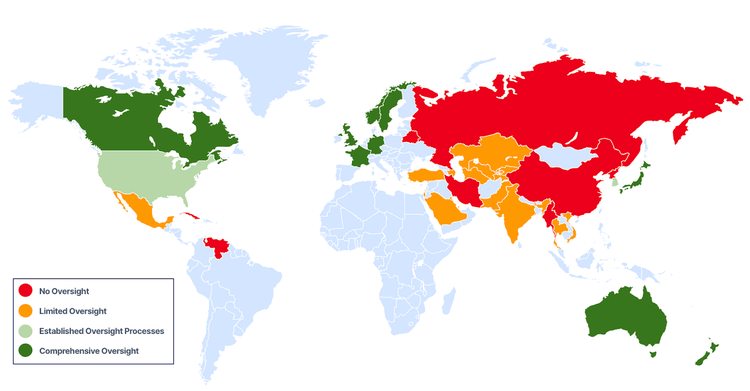
Figure 3: (Left) Graphical representation from the Insikt Group report titled Dark Covenant of the direct and indirect links between Russian Intelligence Services and individuals in the Russian cybercriminal underground; (Right) Infographic of reported cyberattack by Russian state-backed ransomware operators against German military contractors
(Source: Recorded Future)
Outlook
- Cyberattacks are likely to increase as international alliances weaken: The Thailand-Cambodia and India-Pakistan conflicts demonstrate an increased willingness to use force to pursue regional goals. Deployments in multilateral peacekeeping operations decreased by 40% over the last decade, likely due to challenges in generating the necessary support for intervention. This makes it more likely that states will turn to violence to resolve disputes, as opposed to non-violent negotiations. Cyber and influence operations are becoming increasingly common features in these conflicts, serving as a low-cost means of signaling strength, shaping narratives, and imposing limited disruption.
- Cyber capability build-up may follow conventional military build-up: NATO countries in Europe, as well as South Korea and Japan, are increasing their military spending. While many of these countries already have advanced cyber capabilities, they may seek to invest in more sophisticated offensive capabilities to augment conventional forces. Legal and doctrinal changes, such as in Japan and South Korea, are also laying the groundwork for a shift from a defensive cyber policy to an offensive posture.
- Commercial cyber capabilities may be sought for interstate conflict: Countries seeking to gain a cyber advantage in advance of a regional conflict may turn to commercial offensive tools, similar to the growing reliance on these tools for internal law enforcement or counterterrorism operations. This reduces the barrier to entry for smaller or less technically mature states, enabling more actors to conduct sophisticated intrusions, targeted espionage, and high-impact disruption.
Mitigations
- Use Recorded Future’s Geopolitical Intelligence to monitor regional conflicts and geopolitical developments for risks to international and outsourced operations.
- Use Recorded Future’s Threat Intelligence to track threat actor groups and detect TTPs associated with non-Big Four countries.
- Understand the risk of surveillance for personnel traveling to high-risk countries and take mitigating actions such as using alternative devices. Use Recorded Future’s Country Risk Data in the Geopolitical Intelligence module to assess surveillance and other travel risks.
- Ensure continuity-of-operations plans are in place to mitigate the impacts of disruptive or destructive attacks. Use Recorded Future Analyst-on-Demand for bespoke research on how your organization might be targeted.
Risk Scenario
A longstanding territorial dispute between Country A and Country B erupts into a military skirmish at the border, with risks of further escalation. Country A is home to a robust business process outsourcing industry serving some of the world’s largest international corporations.
First-Order Implications
Groups claiming to be patriotic hacktivists from both countries conduct hack-and-leak operations and website defacements. These are amplified by partisans on social media who often exaggerate the impact of these attacks.
- Competitive disadvantage: Hack-and-leak operations expose sensitive internal documents, including proprietary trade secrets and embarrassing communications.
- Increased surveillance risk: The conflict increases domestic surveillance activity in Country B to monitor for internal threats. International employees traveling to Country B are subject to enhanced surveillance.
Second-Order Implications
Actors claiming to be hacktivists supporting Country A escalate cyber operations, carrying out persistent cyberattacks against Country B’s electrical grid. As a result, Country B experiences rolling blackouts in the capital city.
- Operational disruption: The blackouts prevent call centers from performing essential business functions, resulting in significant service delays and revenue losses for corporations worldwide.
- Physical security risk: Anger over blackouts increases public support for escalating operations against Country A. The escalation of conflict increases the risk of harm to employees or the destruction of facilities.
Third-Order Implications
The United States and China become increasingly involved in the conflict between Country A and Country B, providing military, logistical, and cyber capabilities to their preferred country. The external support prolongs the conflict and increases the risk of involving neighboring countries.
- Conflict escalation: With more weapons and logistical support from great power backers, fighting between Country A and Country B expands from the border to strikes further in the interior. Both military and civilian casualties increase as violence escalates.
- Regional economic impact: Extended disruptions may cause international corporations to move operations to more stable regions, leading to a negative economic impact in the region.
Further Reading
- Influence Operations and Conflict Escalation in South Asia
- New APT32 Malware Campaign Targets Cambodian Government
- From Pegasus to Pall Mall: Managing Risks of Offensive Cyber Capabilities
- Current Trends in the Turkish Language Dark Web
Source: RecordedFuture
Source Link: https://www.recordedfuture.com/research/cyber-geopolitical-battlefield