Google unveils Gemini 4 Argon, a frontier AI model built for coding, enterprise work, and autonomous cybersecurity defense, rolling out to trusted testers.
Google announced Gemini 4 Argon, and it’s not going straight to the public. It’s rolling out first to a set of trusted cyber defenders through what Google calls the Fairwind Program, which tells you something about where the company thinks this model’s sharpest edge actually is.
Argon is priced to start at $2 per million input tokens and $10 per million output tokens, with cached inputs at a 95% discount, before jumping to $4 and $20 once the introductory window closes. More interesting than the price is the output limit: 1 million tokens, up from 64,000 on the previous generation. It means the model can keep reasoning through a genuinely long, complicated problem in one continuous pass instead of getting cut off mid-thought.
“To support Gemini 4 Argon’s capabilities across longer, more complex use cases, we are significantly expanding the model’s output token limit to an industry-leading 1M tokens, up from the previous 64K tokens.” reads the announcement. “When the model has the headroom to think deeply and generate hundreds of thousands of tokens in a single trajectory, it adds a new level of depth in reasoning to solve tough problems in one go.”
Google engineers are already using Argon internally, with some impressive results. In one case, Argon helped quantum computing researchers optimize a resource-heavy process and improve the published baseline by 40% in just a few minutes. In another, Argon agents analyzed data from Google’s data centers and found memory optimizations that freed more than 300 TiB after deployment. Google estimates there could be another 500 TiB to 1 PiB of savings.
Argon is also being used to rewrite C and C++ code in Rust. This includes Google’s Fuchsia Zircon kernel, which has more than 800,000 lines of code. For the open-source libgav1 video decoder, Argon replaced 32,000 lines of SIMD code through repeated testing and compiler analysis. The new version runs 2.7 times faster than the previous Rust version, produces the same video output, and remains memory-safe.
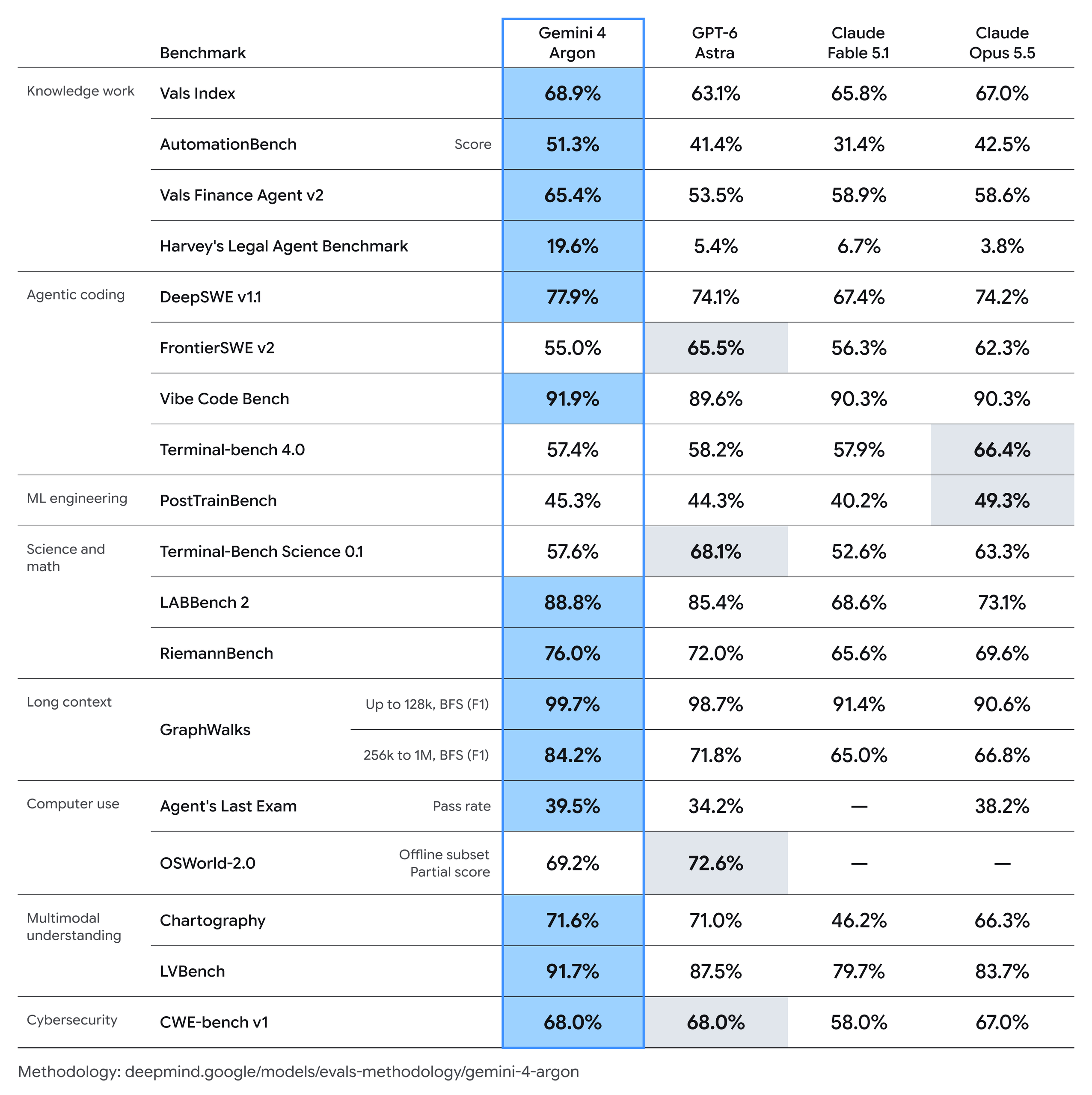
On benchmarks, Argon tops DeepSWE v1.1 at 77.9% for long-horizon software engineering, leads the Vals Index across finance, legal, and tax work, and ranks first on Zapier’s AutomationBench at 51.3%. It also posts a state-of-the-art 91.7% on LVBench, a benchmark for understanding long video, which matters more than it sounds for any workflow that involves parsing hours of footage or a stack of visual documents instead of clean text.
Cybersecurity is one of the main areas where Google is focusing Argon. For trusted security teams and Google’s own engineers, Argon runs without its usual cyber safety restrictions. This allows it to actively look for vulnerabilities that defenders can then fix.
Wiz is already using Argon through its Scan for Good program, which looks for serious vulnerabilities in public systems and fixes them for free. Argon found a critical flaw in healthcare software used by hospitals worldwide that could expose personal data. Earlier AI models had examined the same issue but failed to find it. On CWE-bench v1, a test that measures how well AI models can fix vulnerabilities, Argon scored 68%, tying for first place.
None of this means Google is releasing a model that can autonomously hack things and calling it a day. Before any broader rollout, the company says it’s hardening defenses on four separate fronts: blocking misuse for cyber or CBRN attacks while still allowing legitimate dual-use research, improving resistance to indirect prompt injection, where hidden instructions try to hijack the model’s behavior, and sealing off the sandboxed environments used for high-risk training and testing before anything risky happens inside them.
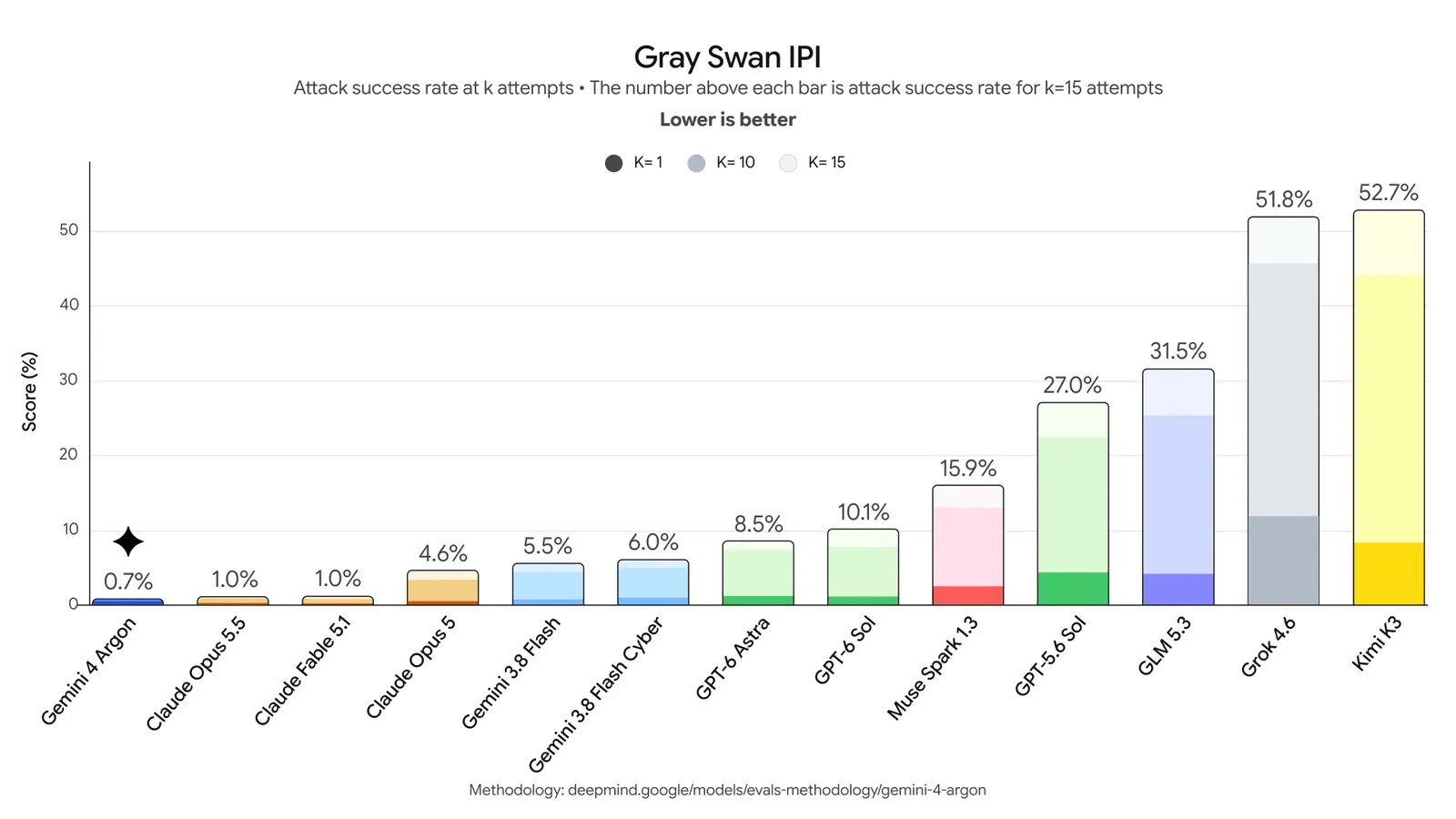
“Argon is also our most resilient model yet against indirect prompt injections, where malicious instructions or context are used to hijack a model’s behavior.” Google states. “These are complex attacks that require constant vigilance and multiple layers of defense. Through automated red teaming and adversarial training, Gemini 4 Argon is leading in prompt injection robustness on the Gray Swan’s Indirect Prompt Injection (IPI) benchmark.”
The misalignment piece is the one that actually says something about how seriously Google is taking all this. Argon’s chain-of-thought and actions get monitored in real time, with execution halted if the model starts drifting past what the user actually asked for, and Google is careful not to feed what that monitoring catches back into training, specifically so the model doesn’t learn to reason its way around its own watchers.
“In order to prevent Argon from stepping out of bounds to try to accomplish a task in a way that goes beyond the user’s intentions, we are deploying misalignment mitigations that monitor Argon’s chain-of-thought and actions and stop execution when necessary.” concludes the announcement. “We strongly encourage the rest of the industry to preserve reasoning transparency in these pivotal moments of increased capabilities while navigating alignment risks, so that model thoughts remain helpful in identifying and diagnosing misalignment.”
Follow me on Twitter: @securityaffairs and Facebook and Mastodon
(SecurityAffairs – hacking, Google Gemini 4 Argon)
Source: SecurityAffairs
Source Link: https://securityaffairs.com/200187/uncategorized/inside-gemini-4-argon-the-model-google-is-testing-on-its-own-infrastructure-first.html