Behind every ransomware demand, botnet, or threat activity group is a server sitting in a data center. While most legitimate hosting providers evict threat actors once identified, a specific class of providers does the opposite. Recorded Future® calls these providers threat activity enablers(TAEs).
What Is a Threat Activity Enabler?
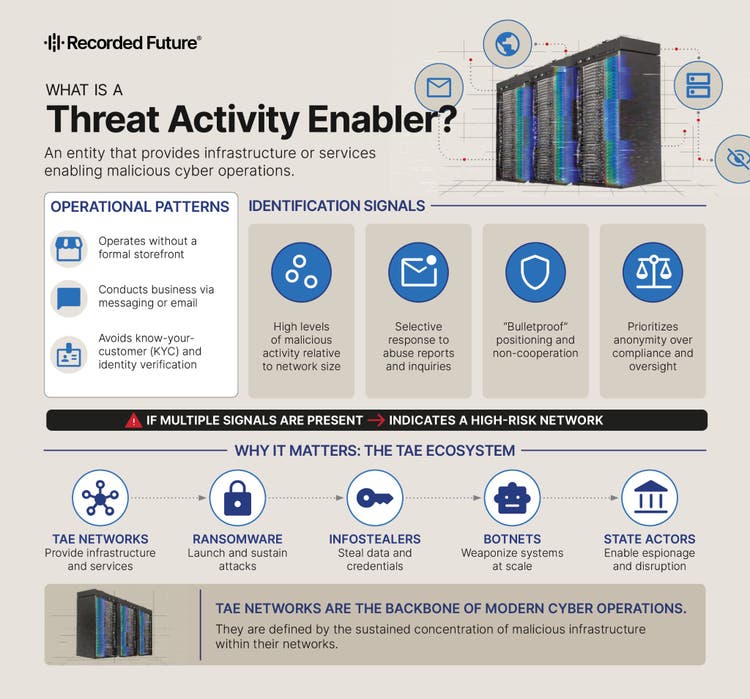
A threat activity enabler (TAE) is an individual, organization, or service provider that supports malicious cyber activity by providing infrastructure or services leveraged by threat actors. More commonly, this includes providers that lack a formal physical or virtual storefront, conduct business only via email or messaging platforms, and do not enforce know-your-customer (KYC) policies. It also includes hosting providers that selectively respond to abuse reports or law enforcement inquiries to maintain plausible deniability, as well as more traditional self-proclaimed “bulletproof� providers that openly ignore oversight or advertise non-cooperation.
TAE networks serve as the backbone for ransomware groups, infostealer campaigns, botnets, and even state-sponsored threat actor operations. What distinguishes TAE networks is the sustained concentration of malicious infrastructure within their networks.
How TAEs Operate
TAEs are masters of obfuscation and are highly resilient, hiding behind layers of decoy companies to evade accountability. They use several core tactics:
- Corporate Shell Games: They establish front companies across multiple jurisdictions to create legal distance between the infrastructure and the operators.
- Strategic Resource Control: They often operate as local internet registries (LIRs). This gives them direct control over IP resources and autonomous systems (ASNs), allowing them to manipulate network resources at will.
- Rapid Rebranding: When a network becomes too "hot" due to scrutiny, TAEs rapidly transfer IP address prefixes to a newly registered, clean-looking entity.
Identifying High-Risk TAE Networks
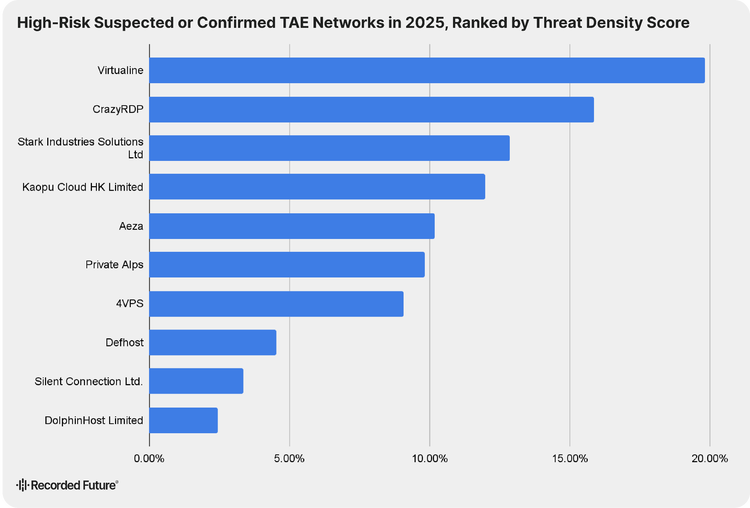
Recorded Future actively identifies high-risk TAE networks through its Network Threat Density List. These networks are ranked by their Threat Density Score, calculated from the concentration of validated malicious activity relative to the total number of IP address prefixes a network announces.
This approach cuts through the noise to quickly expose infrastructure that is disproportionately associated with threat activity, a core characteristic of TAEs, allowing network defenders to prioritize the infrastructure most likely to pose material risk.
From Insight to Action
Tracking TAE networks allows security teams to move from reacting to individual threats to proactively managing infrastructure risk. In practice, this means applying TAE intelligence across three core areas: prevention, detection, and exposure.
Operationalize TAE Intelligence
Source: RecordedFuture
Source Link: https://www.recordedfuture.com/blog/threat-activity-enablers